

Comparison
Glow Blend vs Klow
Glow Blend vs Klow: BPC-157, TB-500 and GHK-Cu, with and without KPV. Composition, fill amount and the evidence behind each component. Research use only.
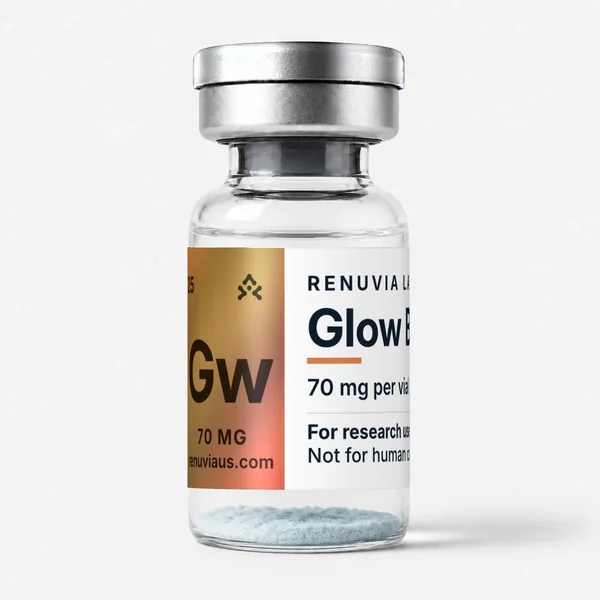
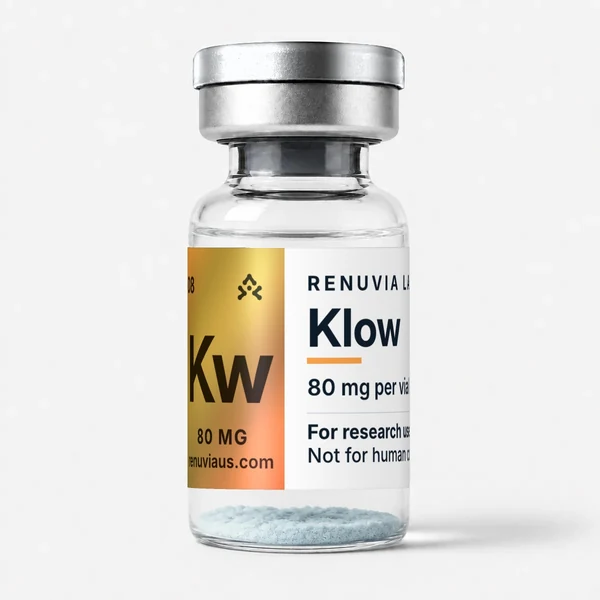
Side by side
| Specification | Glow Blend | Klow |
|---|---|---|
| Category | Blends | Blends |
| Form | Lyophilized powder | Lyophilized powder |
| Fill amount | 70 mg | 80 mg |
| Research status | Preclinical — blend not studied | Preclinical — blend not studied |
| Evidence levels | in-vitro, animal, early-clinical | in-vitro, animal, early-clinical |
| Cited sources | 10 | 6 |
Identifiers describe the compound as listed on each product page; see each page for the source of every value. Purity and testing results appear only on a published Certificate of Analysis.
What this comparison covers
Both products are multi-peptide research blends supplied as lyophilized powder in a single sealed vial. Glow Blend combines three peptides, BPC-157, TB-500 and GHK-Cu; Klow is a trade name for the same three plus a fourth, KPV. This page sets the two side by side on composition, fill amount and the state of the published evidence for each component.
It does not rank them. Neither blend has its own body of peer-reviewed research, and this page makes no statement about use, administration or outcomes. Every scientific claim below is drawn from the sources listed at the end.
Shared ground
Three ingredients are common to both vials. BPC-157 is a 15-amino-acid peptide whose sequence comes from a protein isolated from human gastric juice; a 2025 systematic review of its orthopaedic research found 35 preclinical studies and a single human case series, all low-level evidence [1]. TB-500 is the N-terminally acetylated 17–23 fragment of thymosin β4 (Ac-LKKTETQ), characterized in a 2012 anti-doping study [2]. GHK-Cu is the copper(II) complex of the plasma tripeptide Gly-His-Lys, studied in fibroblast cultures, animal wound models and small topical cosmetic studies in people [3][4].
Both blends therefore inherit the same caveats. No study has examined either fixed mixture. The only experiment that tested any two of these ingredients together, a 2026 rat Achilles-tendon study of BPC-157 and TB-500, reported no additional effect on the measured outcomes from combining them compared with either peptide alone [5]. FDA lists BPC-157, the TB-500 fragment and injectable GHK-Cu among compounding bulk substances that were nominated and withdrawn, citing possible immunogenicity and limited or no human safety data [6]. On July 23, 2026 an FDA advisory committee voted to recommend adding BPC-157 and TB-500 (and also KPV) to the 503A bulks list; the votes are nonbinding and require rulemaking [7]. BPC-157 and TB-500 appear on the WADA 2026 Prohibited List [8].
Both are sold by Renuvia Labs for laboratory research use only, with the same documentation: component identifiers on the product page and a lot Certificate of Analysis published in the COA library once testing is complete.
How they differ
Composition is the main difference. Klow adds KPV, the tripeptide Lys-Pro-Val that forms residues 11–13 of α-melanocyte-stimulating hormone [9]. Glow Blend does not contain it. The other three components are the same peptides in both vials.
Fill amount differs accordingly. Glow Blend is a 70 mg vial listed as 10 mg BPC-157, 10 mg TB-500 and 50 mg GHK-Cu. Klow is an 80 mg vial; its per-component amounts have not yet been confirmed and are not stated here. The listing says they will be given with each lot's Certificate of Analysis. Because both are mixtures, neither has a single sequence, formula or CAS number of its own.
The evidence base differs by one research tradition. KPV has been studied in intestinal cell lines and mouse colitis models, where it is carried into cells by the peptide transporter PepT1 and was associated with reduced NF-κB and MAP-kinase inflammatory signaling [9]. FDA has stated it identified no human exposure data for KPV [6]. KPV has not been studied in combination with any of the other three components.
Which research questions each is associated with
Glow Blend is associated in the literature with connective-tissue questions: tendon, ligament and muscle injury models in rodents for BPC-157 [1], the actin-binding region of thymosin β4 for TB-500 [2], and collagen production by cultured fibroblasts and animal wound models for GHK-Cu [3][4].
Klow is associated with those same questions plus intestinal inflammation, where KPV has been examined in cell and mouse experiments [9].
In both cases the research belongs to the individual ingredients, mostly at the cell and animal level. Researchers choosing between the vials are choosing which set of component peptides, and which set of unanswered questions, they want to work with.
Questions researchers ask
- What is the difference between Glow Blend and Klow?
- Glow Blend contains BPC-157, TB-500 and GHK-Cu in a 70 mg vial. Klow contains the same three plus KPV, in an 80 mg vial. KPV is the only ingredient in one and not the other.
- Why is there no sequence, molecular weight or CAS number for either blend?
- Those identifiers describe a single compound. Both products are mixtures, so the product pages list identifiers per component where they have been verified, and the blend itself has none.
- Has either blend been studied as a combination?
- No peer-reviewed study of either fixed mixture was identified. One 2026 rat tendon study tested BPC-157 and TB-500 alone and together and found no additional effect from the combination on the measured outcomes [5]. Neither the three-way nor the four-way mixture has been studied.
- What should a Certificate of Analysis for these blends show?
- Identity confirmation for every component (three for Glow Blend, four for Klow), ideally the measured amount or ratio of each against the label, a chromatogram with assigned peaks, and the lot number, method, laboratory and date. A single purity figure does not confirm the ratio.
- Are these products for human use?
- No. Both are sold for laboratory research use only by qualified researchers. They are not drugs, dietary supplements, cosmetics or foods and have not been evaluated by the FDA for any use.
Sources
- Vasireddi N, et al. Emerging Use of BPC-157 in Orthopaedic Sports Medicine: A Systematic Review. HSS J 2025
- Esposito S, et al. Synthesis and characterization of the N-terminal acetylated 17-23 fragment of thymosin beta 4 identified in TB-500. Drug Test Anal 2012
- Maquart FX, et al. Stimulation of collagen synthesis in fibroblast cultures by the tripeptide-copper complex glycyl-L-histidyl-L-lysine-Cu2+. FEBS Lett 1988
- Pickart L, Margolina A. Regenerative and Protective Actions of the GHK-Cu Peptide in the Light of the New Gene Data. Int J Mol Sci 2018
- Biçer O, et al. Effects of BPC-157 and TB-500 on Achilles tendon healing in rats. Jt Dis Relat Surg 2026
- FDA. Certain bulk drug substances for use in compounding that may present significant safety risks (updated April 2026)
- DLA Piper. FDA advisory committee recommends adding six peptides to bulk list. July 31, 2026
- WADA. The 2026 Prohibited List (in effect January 1, 2026), sections S0 and S2.3
- Dalmasso G, et al. PepT1-mediated tripeptide KPV uptake reduces intestinal inflammation. Gastroenterology 2008
For laboratory research use only by qualified researchers. Not for human or veterinary use. Not a drug, dietary supplement, cosmetic or food. Not evaluated by the FDA for any use.