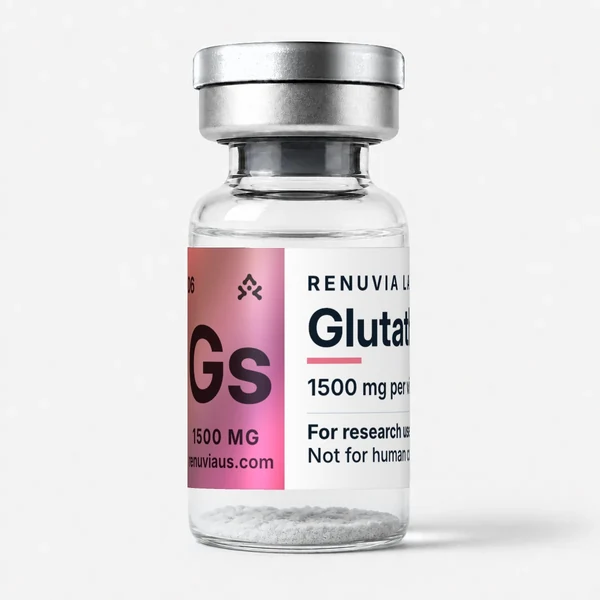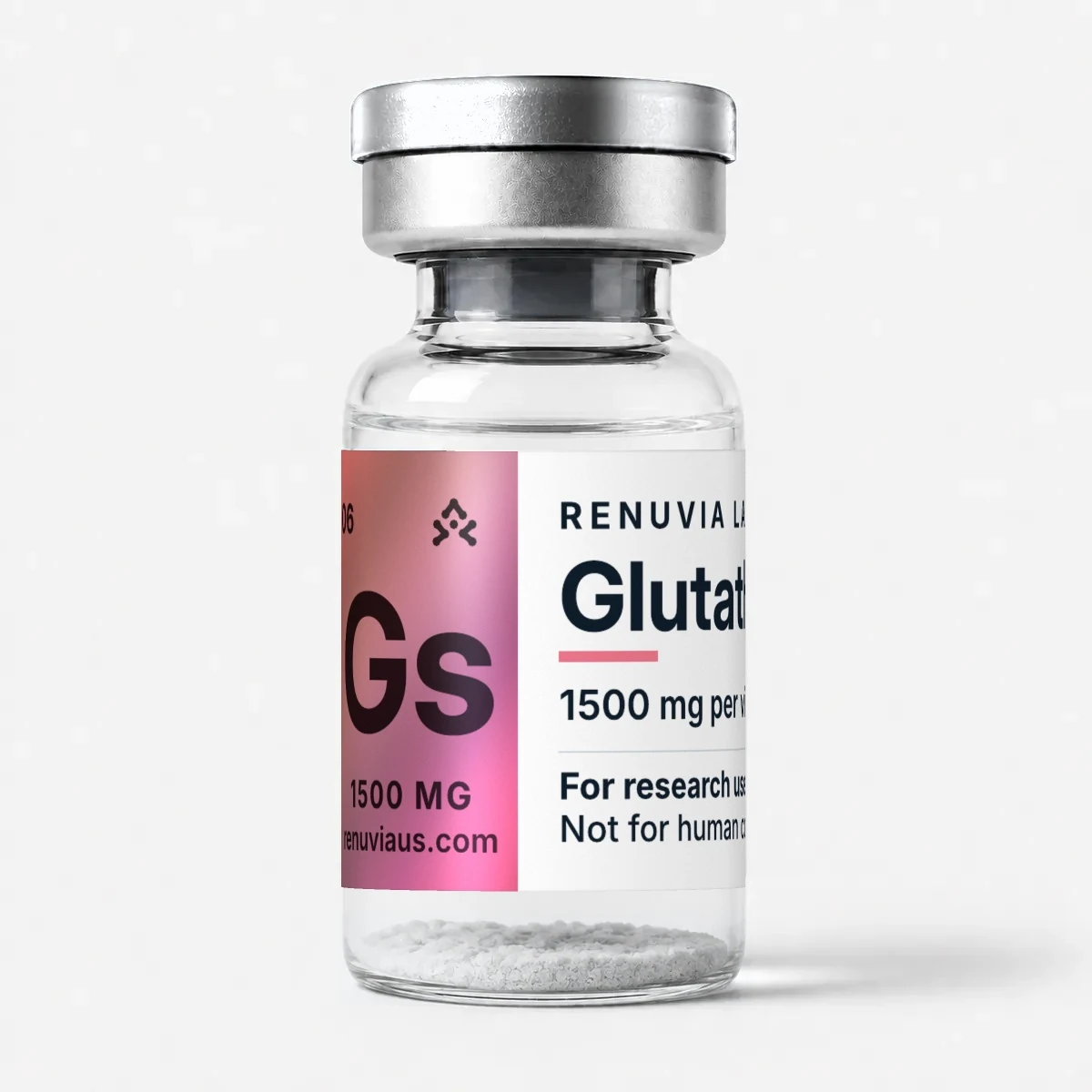
Glutathione
1500 mg · Lyophilized powder
In Stock
L-Glutathione (γ-Glu-Cys-Gly) tripeptide.
Need larger quantities? Wholesale pricing for qualified businesses
or
Pay by Zelle at checkout. Ships 1 to 3 business days after payment is confirmed. How ordering works
For laboratory research use only by qualified researchers. Not for human or veterinary use. Not a drug, dietary supplement, cosmetic or food. Not evaluated by the FDA for any use.
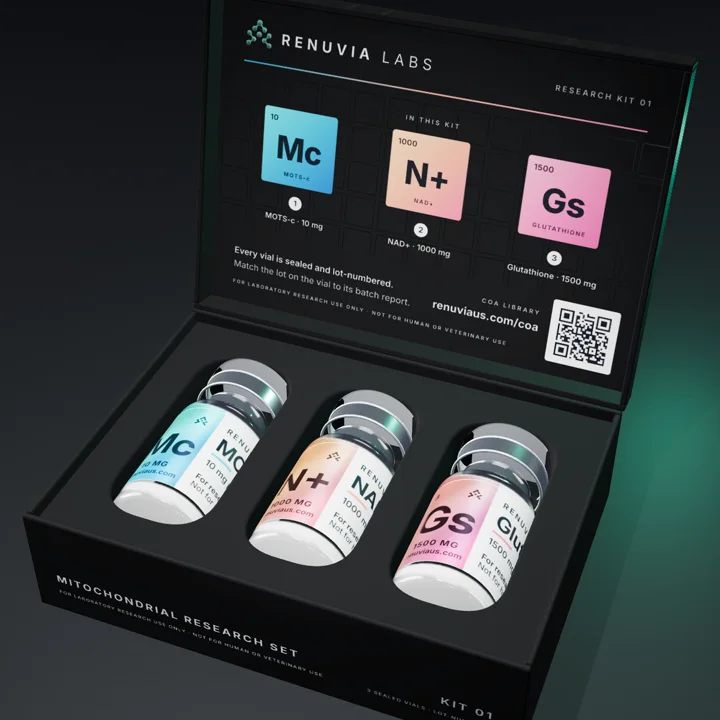 Research Kit 01 · save 15%With MOTS-c and NAD+: this vial is $39.94, all three $199.74 $234.99See the Mitochondrial Research Set
Quick Summary
Established biology — supplementation evidence limitedGlutathione is a three-amino-acid molecule (glutamate, cysteine and glycine) that cells make themselves. It is the main small antioxidant inside cells and helps neutralize reactive molecules and foreign chemicals. Its role in cells is well established; the effects of supplemented glutathione in people are uncertain.
Areas of research
- Oxidative stress and redox signaling
- Glutathione synthesis and regulation
- Xenobiotic detoxification
- Oral supplementation and body stores
- Immune function
- Amount
- 1500 mg
- Form
- Lyophilized powder
- References
- 4 cited
- COA
- Published
- Free U.S. shipping on orders of $150 or more
- Lyophilized powder in a sealed vial
- Batch COA available
Research Use Notice. This product is intended for laboratory and research purposes. It is not intended for human consumption or personal medical use. Product information is provided for scientific and educational context only. See our Research Use Policy.
Why Researchers Study It
- The main antioxidant defense inside cells
- Redox signaling and oxidative stress
- Detoxification of foreign chemicals
- Whether supplemented glutathione raises the body's own stores
What It Is
Glutathione is a tripeptide made of glutamate, cysteine and glycine, linked through an unusual γ-glutamyl bond (γ-Glu-Cys-Gly).
Glutathione is a tripeptide made of glutamate, cysteine and glycine, linked through an unusual γ-glutamyl bond (γ-Glu-Cys-Gly). Cells make it themselves, and in cells it exists mostly (over 98%) in its reduced form, often abbreviated GSH.
It is made in two energy-requiring steps by the enzymes glutamate-cysteine ligase and glutathione synthetase.
Glutathione is the main small-molecule antioxidant inside cells, so it is central to research on oxidative stress, redox signaling and the detoxification of foreign chemicals. It also has roles in cell growth, cell death and immune function.
A separate research question is whether glutathione given from outside the body raises the body's own stores. Controlled trials of oral glutathione have produced mixed results.
How It Works
3 established · 2 proposed or under investigation
Established
- Acts as the predominant cellular antioxidant against oxidative stress
- Synthesis is limited by glutamate-cysteine ligase and regulated by transcription factors including Nrf2
- Participates in detoxifying foreign compounds (xenobiotics)
Proposed / under investigation
- Whether oral or other supplemental glutathione meaningfully raises tissue levels in people
- Downstream effects of supplementation on immune markers, such as natural killer cell activity
Research Status & Evidence
Established biology — supplementation evidence limited
Glutathione's role inside cells is established by decades of biochemistry; small human supplementation trials have given mixed results.
Types of evidence
- Available: Cell & lab studies
- Not available: Animal studies
- Available: Early human studies
- Not available: Clinical trials
- Not available: Approved medical use
Glutathione's role inside cells is well established by decades of biochemistry. Evidence on supplemented glutathione is limited and mixed: a 6-month trial in 54 adults reported higher glutathione in blood cells, while a 4-week trial in 40 adults found no change in glutathione status or oxidative-stress markers.
Areas of research
- Oxidative stress and redox signalingcore cell biology
- Glutathione synthesis and regulationenzymes and Nrf2 signaling
- Xenobiotic detoxificationcellular defense against foreign chemicals
- Oral supplementation and body storessmall randomized trials
- Immune functionimmune-cell markers in supplementation studies
Limitations
- Its biological role inside cells is established; the effects of supplemented or administered glutathione are not
- Human supplementation trials are small, short and inconsistent
- No FDA-approved glutathione drug product was identified; it is a nominated compounding substance under FDA evaluation
Specifications
1500 mg · Lyophilized powder · CAS 70-18-8
- Product
- Glutathione
- Category
- Research Compounds
- Size
- 1500 mg
- Form
- Lyophilized powder
- Synonyms
- L-Glutathione; GSH; Reduced glutathione; γ-L-glutamyl-L-cysteinylglycine
- CAS number
- 70-18-8
- Molecular formula
- C10H17N3O6S
- Molecular weight
- 307.33 g/mol
- Sequence
- γ-Glu-Cys-Gly (γ-L-glutamyl-L-cysteinylglycine)
- PubChem CID
- 124886
- SKU
- REN-GLUT-10
Molecular data: Reduced glutathione, GSH (PubChem).
Testing & COA Batch report available
- Batch VB-2609-01-EZ · HPLC-DAD · Supplier COA (KMD Analytical) · 2026-10-0799.51% purity · Identity: confirmed · 1,540 mg measured (102.7% of label)View COA
Research References (4)
Linked sources · last reviewed September 2026
- Lu SC. Glutathione synthesis. Biochim Biophys Acta 2013 · PubMed 22995213
- Richie et al. Randomized controlled trial of oral glutathione supplementation on body stores of glutathione. Eur J Nutr 2015 · link.springer.com
- Allen & Bradley. Effects of oral glutathione supplementation on systemic oxidative stress biomarkers in human volunteers. J Altern Complement Med 2011 · PubMed 21875351
- FDA. Bulk Drug Substances Nominated for Use in Compounding Under Section 503A (updated May 14, 2026) · fda.gov
Summaries are written by Renuvia Labs from the sources above for educational context only. Last reviewed September 28, 2026.
Frequently Asked Questions
What is Glutathione?
Glutathione is a three-amino-acid molecule (glutamate, cysteine and glycine) that cells make themselves. It is the main small antioxidant inside cells and helps neutralize reactive molecules and foreign chemicals. Its role in cells is well established; the effects of supplemented glutathione in people are uncertain.
Is there a Glutathione coupon or discount code?
There is no public coupon code. New customers get a first-order discount for joining the Renuvia email list, volume pricing starts at 2 vials of Glutathione, and U.S. shipping is free over $150. Codes on third-party coupon sites are not valid here.
What are other names for Glutathione?
Glutathione is also referred to as L-Glutathione, GSH, Reduced glutathione, γ-L-glutamyl-L-cysteinylglycine.
What are the CAS number and molecular weight of Glutathione?
Glutathione: CAS number 70-18-8; molecular formula C10H17N3O6S; molecular weight 307.33 g/mol; PubChem CID 124886. Sequence: γ-Glu-Cys-Gly (γ-L-glutamyl-L-cysteinylglycine). (Reduced glutathione, GSH (PubChem).)
What sizes is Renuvia Labs Glutathione available in?
Glutathione is listed in 1500 mg, supplied as lyophilized powder in a sealed glass vial. It is sold for laboratory research use only.
Where is the Certificate of Analysis for Glutathione?
Certificates of Analysis are published per lot in the Renuvia Labs COA library, searchable by product, SKU or lot number. Glutathione shows "pending" there until the current lot's report exists; it is then linked on this page too.
What form is this product supplied in?
Peptides and research compounds ship as lyophilized (freeze-dried) powder in a sealed glass vial. The fill amount printed on the product page and label is the total content of the vial.
Is this product for human use?
No. All Renuvia Labs products are sold strictly for laboratory research use. They are not for human or animal consumption and are not intended to diagnose, treat, cure or prevent any disease.
Do you offer volume pricing?
Yes. Per-vial pricing drops automatically at 2, 3 and 5 vials of the same product; the current tiers are shown next to the price. For larger quantities, see our wholesale program.
How much is shipping?
Free U.S. shipping on orders of $150 or more; $8.95 flat rate below that.
Do you ship outside the U.S.?
No. Renuvia Labs ships to U.S. addresses only. Research institutions outside the U.S. can enquire through the wholesale program.