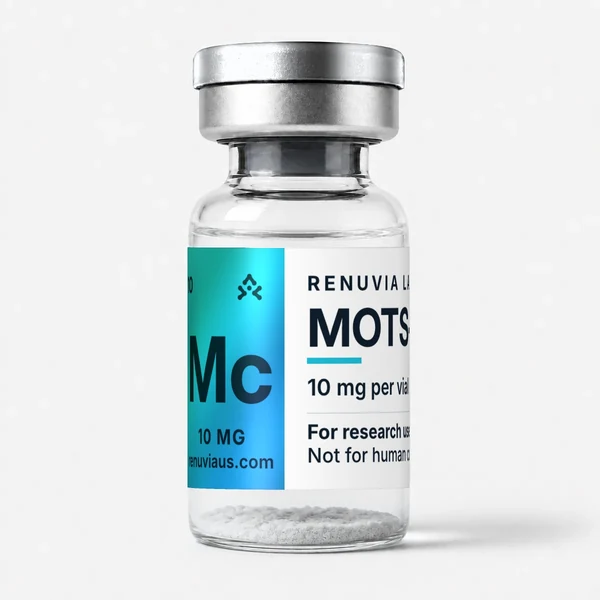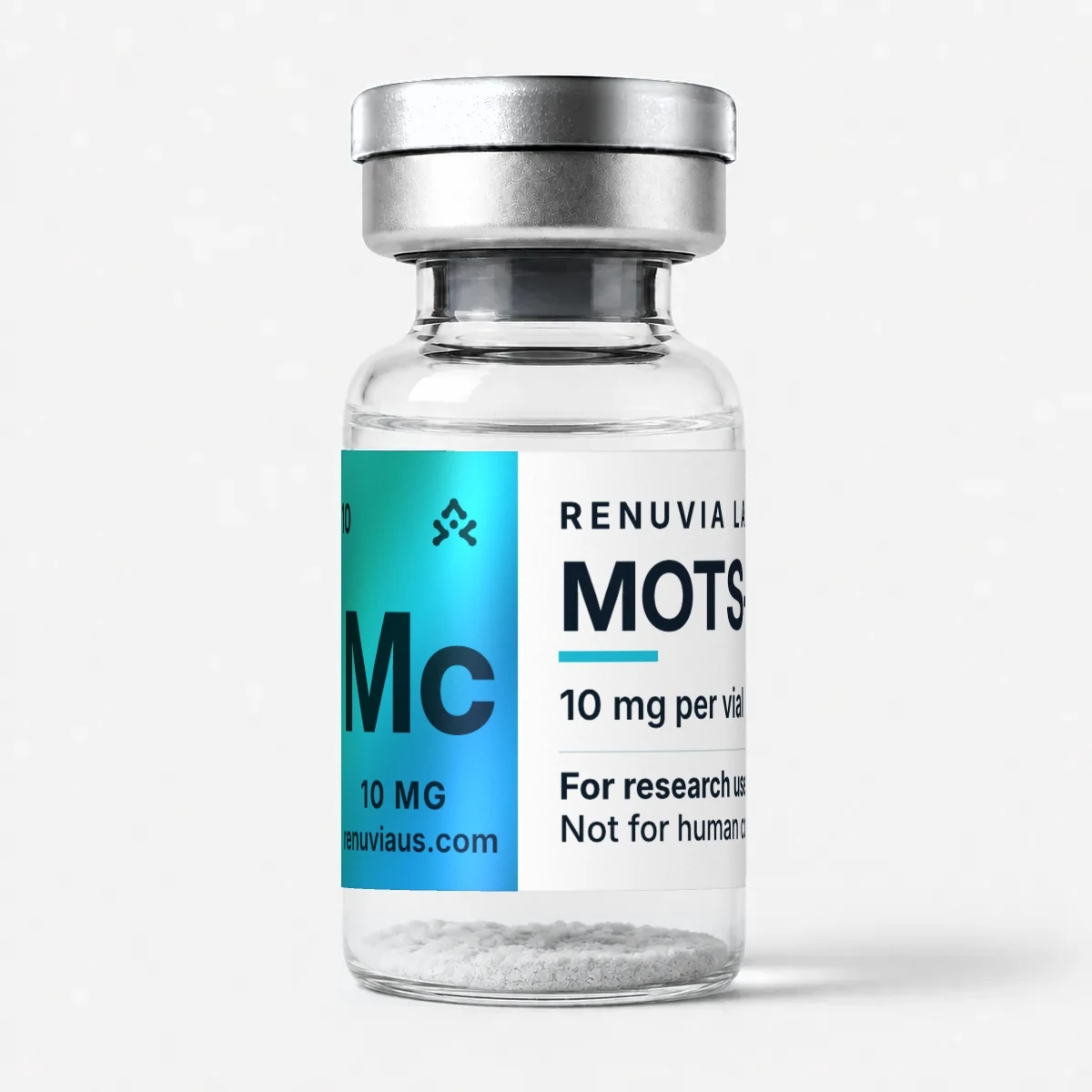
MOTS-c
In stock10 mg · Lyophilized powder
In stock · reserve now
Mitochondrial-derived 16-amino-acid research peptide.
Need larger quantities? Wholesale pricing for qualified businesses
or
For laboratory research use only by qualified researchers. Not for human or veterinary use. Not a drug, dietary supplement, cosmetic or food. Not evaluated by the FDA for any use.
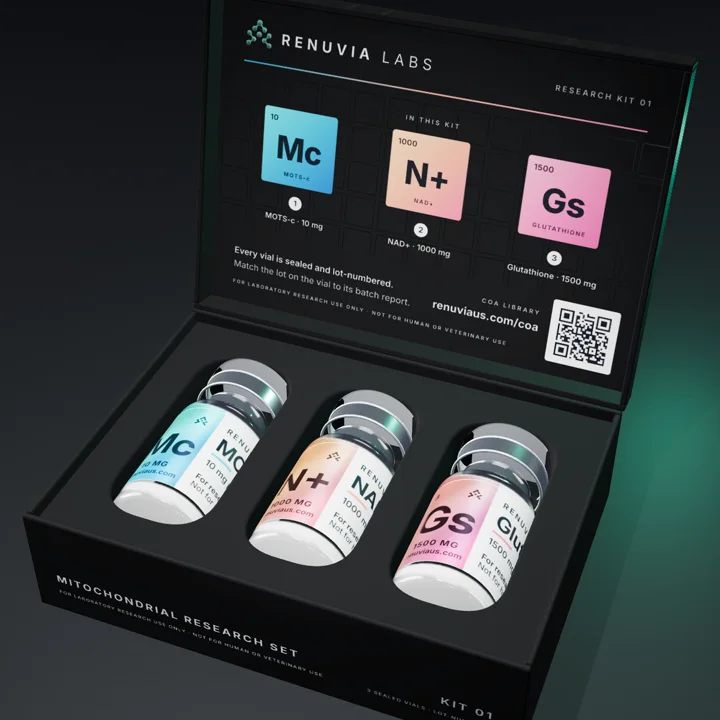 Research Kit 01 · save 15%With NAD+ and Glutathione: this vial is $58.65, all three $199.74 $234.99See the Mitochondrial Research Set
How ordering works
This product is in stock. Reserve it now; no payment is collected today. Estimated availability is approximately 1–2 business days. We'll contact you when your reservation is ready for payment.
- 1Reserve todayNo payment now
- 2We confirm itAbout 1–2 business days
- 3Payment requestBy email, with a secure link
- 4ShipsTracking by email
Quick Summary
Preclinical — not approvedMOTS-c is a 16-amino-acid peptide encoded in mitochondrial DNA, part of a small family of "mitochondrial-derived peptides." It has been studied in cells and mice for its role in metabolic signaling, insulin sensitivity and the response to exercise. Human data are very limited, and it is not approved.
Areas of research
- Insulin sensitivity
- Exercise physiology
- Age-related physical decline
- Fatty liver and obesity
- Amount
- 10 mg
- Form
- Lyophilized powder
- References
- 5 cited
- COA
- Published
- Free U.S. shipping on orders of $150 or more
- Lyophilized powder in a sealed vial
- Batch COA available
Research Use Notice. This product is intended for laboratory and research purposes. It is not intended for human consumption or personal medical use. Product information is provided for scientific and educational context only. See our Research Use Policy.
Why Researchers Study It
- Evidence that mitochondria make their own signaling molecules
- Insulin sensitivity and diet-induced weight gain in mouse models
- Exercise physiology: levels in muscle and blood rise during exercise in young adults (observational)
- Proposed action through AMPK, a cellular energy sensor
What It Is
MOTS-c is a 16-amino-acid peptide encoded not in the cell nucleus but in mitochondrial DNA, within the region that codes for 12S ribosomal RNA.
MOTS-c is a 16-amino-acid peptide encoded not in the cell nucleus but in mitochondrial DNA, within the region that codes for 12S ribosomal RNA. It was first described in 2015.
It belongs to a small group of mitochondrial-derived peptides that scientists think may let mitochondria send signals to the rest of the cell and body.
MOTS-c is of research interest because it suggests mitochondria make their own signaling molecules. In mice fed a high-fat diet, it was reported to reduce weight gain and age-related insulin resistance, mostly through effects in skeletal muscle.
A 2021 study found MOTS-c levels rose in muscle and blood of young adults during exercise, and that treating older mice improved physical performance. These findings have prompted interest in metabolism and aging, but human data remain very limited.
How It Works
1 established · 2 proposed or under investigation
Established
- Encoded by a short open reading frame in the mitochondrial 12S rRNA gene
Proposed / under investigation
- Inhibits the folate cycle and purine synthesis, leading to buildup of AICAR and activation of AMPK, an energy-sensing enzyme (mouse and cell work)
- Acts as an exercise-responsive signal supporting muscle function in aging mice
Research Status & Evidence
Preclinical — not approved
Most evidence is from cells and mice. The only human interventional study found used a modified analog (CB4211), not MOTS-c itself.
Types of evidence
- Available: Cell & lab studies
- Available: Animal studies
- Available: Early human studies
- Not available: Clinical trials
- Not available: Approved medical use
Most of the foundational research comes from one group and its collaborators, and is in cells and mice. The only human interventional study found was a phase 1a/1b trial of a modified analog, CB4211, not MOTS-c itself; development stopped when its sponsor, CohBar, dissolved. Human exercise data are observational.
Areas of research
- Insulin sensitivityhigh-fat-diet and aging mouse models
- Exercise physiologyexercise-induced rises in muscle and blood levels
- Age-related physical declineperformance in older mice
- Fatty liver and obesityearly human trial of analog CB4211
Limitations
- Not approved by the FDA or any other regulator; no completed human trials of native MOTS-c were found
- The analog CB4211 lowered liver enzymes in a small 28-day phase 1b study, but liver fat fell about equally with placebo, and injection-site reactions were common
- An FDA advisory committee narrowly voted (7-5, 2 abstaining) in July 2026 to recommend it for the 503A bulks list; this is non-binding and no final FDA rule exists
- Prohibited at all times in sport under WADA's AMPK activator category
Specifications
10 mg · Lyophilized powder · CAS 1627580-64-6
- Product
- MOTS-c
- Category
- Peptides
- Size
- 10 mg
- Form
- Lyophilized powder
- Synonyms
- Mitochondrial ORF of the 12S rRNA type-c; Mitochondrial open reading frame of the 12S rRNA-c; Mitochondria-derived peptide MOTS-c
- CAS number
- 1627580-64-6
- Molecular formula
- C101H152N28O22S2
- Molecular weight
- 2174.6 g/mol
- Sequence
- MRWQEMGYIFYPRKLR
- PubChem CID
- 146675088
- SKU
- REN-MOTSC-10
Molecular data: Free peptide (PubChem).
Testing & COA Batch report available
- Batch VB-2609-01-BR · HPLC-DAD · Supplier COA (KMD Analytical) · 2026-10-0799.31% purity · Identity: confirmed · 11.17 mg measured (111.7% of label)View COA
Research References (5)
Linked sources · last reviewed September 2026
- Lee C et al. The mitochondrial-derived peptide MOTS-c promotes metabolic homeostasis and reduces obesity and insulin resistance. Cell Metab 2015 · PubMed 25738459
- Reynolds JC et al. MOTS-c is an exercise-induced mitochondrial-encoded regulator of age-dependent physical decline and muscle homeostasis. Nat Commun 2021 · nature.com
- Alzheimer's Drug Discovery Foundation. Cognitive Vitality report: MOTS-c (updated 2025) · alzdiscovery.org
- FDA. July 23-24, 2026 meeting of the Pharmacy Compounding Advisory Committee · fda.gov
- WADA. The 2026 Prohibited List, section S4.4.1 (copy published by JADCO) · jadco.gov.jm
Summaries are written by Renuvia Labs from the sources above for educational context only. Last reviewed September 28, 2026.
Frequently Asked Questions
What is MOTS-c?
MOTS-c is a 16-amino-acid peptide encoded in mitochondrial DNA, part of a small family of "mitochondrial-derived peptides." It has been studied in cells and mice for its role in metabolic signaling, insulin sensitivity and the response to exercise. Human data are very limited, and it is not approved.
Is there a MOTS-c coupon or discount code?
There is no public coupon code. New customers get a first-order discount for joining the Renuvia email list, volume pricing starts at 2 vials of MOTS-c, and U.S. shipping is free over $150. Codes on third-party coupon sites are not valid here.
What are other names for MOTS-c?
MOTS-c is also referred to as Mitochondrial ORF of the 12S rRNA type-c, Mitochondrial open reading frame of the 12S rRNA-c, Mitochondria-derived peptide MOTS-c.
What are the CAS number and molecular weight of MOTS-c?
MOTS-c: CAS number 1627580-64-6; molecular formula C101H152N28O22S2; molecular weight 2174.6 g/mol; PubChem CID 146675088. Sequence: MRWQEMGYIFYPRKLR. (Free peptide (PubChem).)
What sizes is Renuvia Labs MOTS-c available in?
MOTS-c is listed in 10 mg, supplied as lyophilized powder in a sealed glass vial. It is sold for laboratory research use only.
Where is the Certificate of Analysis for MOTS-c?
Certificates of Analysis are published per lot in the Renuvia Labs COA library, searchable by product, SKU or lot number. MOTS-c shows "pending" there until the current lot's report exists; it is then linked on this page too.
Is this in stock?
Yes, unless the page says sold out. You reserve it with no payment today, and we email payment instructions in approximately 1–2 business days. Your order ships once payment arrives.
What form is this product supplied in?
Peptides and research compounds ship as lyophilized (freeze-dried) powder in a sealed glass vial. The fill amount printed on the product page and label is the total content of the vial.
Is this product for human use?
No. All Renuvia Labs products are sold strictly for laboratory research use. They are not for human or animal consumption and are not intended to diagnose, treat, cure or prevent any disease.
Do you offer volume pricing?
Yes. Per-vial pricing drops automatically at 2, 3 and 5 vials of the same product; the current tiers are shown next to the price. For larger quantities, see our wholesale program.
How much is shipping?
Free U.S. shipping on orders of $150 or more; $8.95 flat rate below that.
Do you ship outside the U.S.?
No. Renuvia Labs ships to U.S. addresses only. Research institutions outside the U.S. can enquire through the wholesale program.