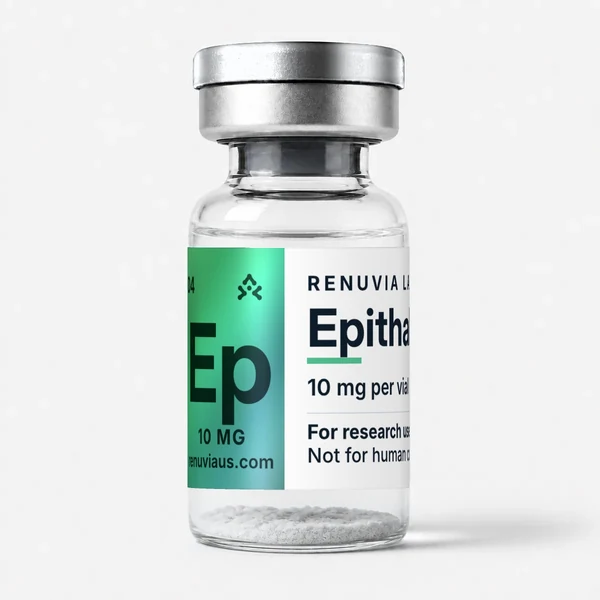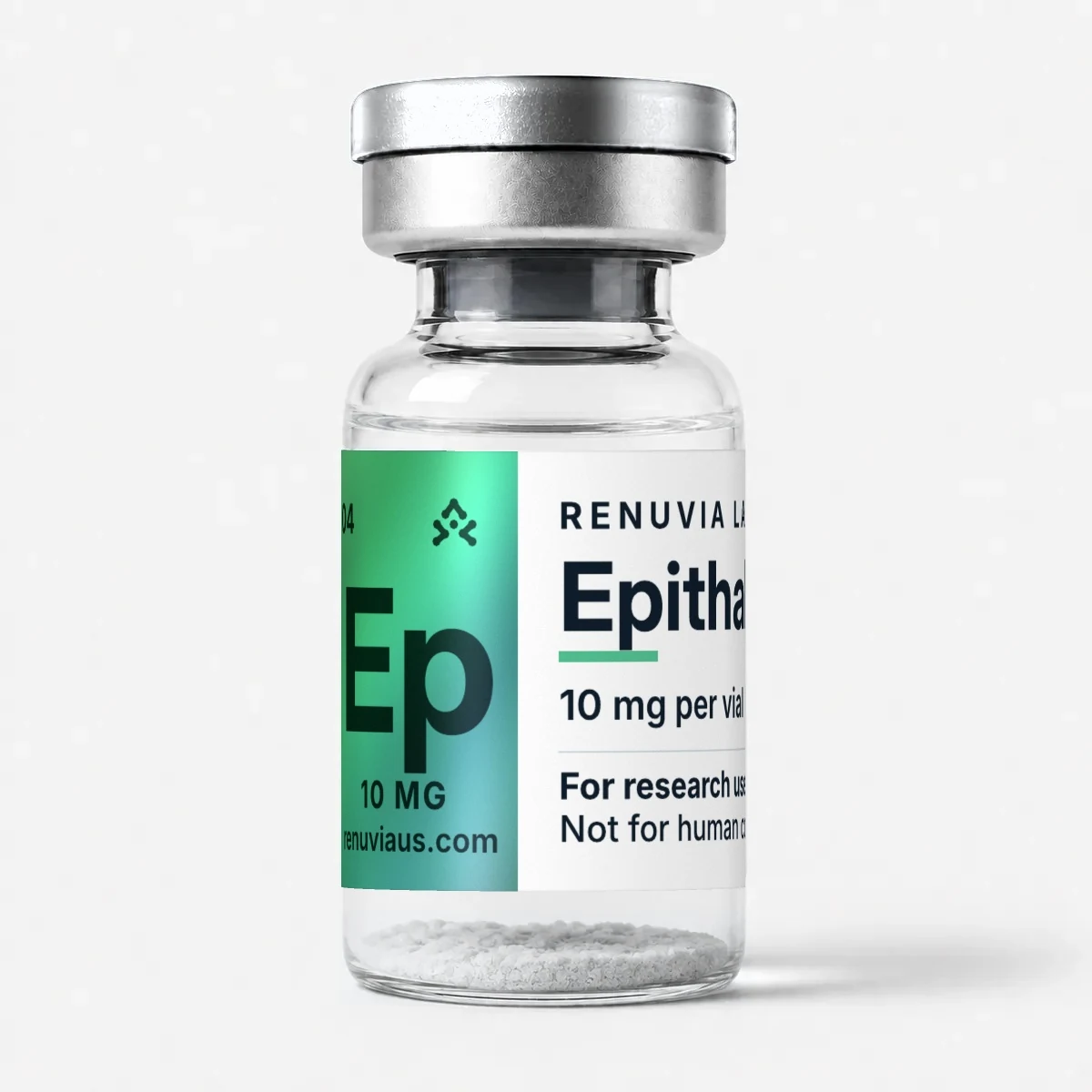
Epithalon
10 mg · Lyophilized powder
In Stock
Synthetic tetrapeptide (Ala-Glu-Asp-Gly).
Need larger quantities? Wholesale pricing for qualified businesses
or
Pay by Zelle at checkout. Ships 1 to 3 business days after payment is confirmed. How ordering works
For laboratory research use only by qualified researchers. Not for human or veterinary use. Not a drug, dietary supplement, cosmetic or food. Not evaluated by the FDA for any use.
Quick Summary
Preclinical — not approvedEpithalon (also spelled Epitalon) is a synthetic four-amino-acid peptide, Ala-Glu-Asp-Gly, designed from a pineal gland extract by Russian aging researchers. It has been studied in cells and animals for effects on telomerase, the enzyme that maintains chromosome ends, and on pineal function. Most of the research comes from one group, human data are sparse, and it is not approved.
Areas of research
- Telomerase and telomere length
- Pineal gland and melatonin
- Lifespan and aging biomarkers
- Spontaneous tumor incidence
- Oxidative stress
- Amount
- 10 mg
- Form
- Lyophilized powder
- References
- 4 cited
- COA
- Published
- Free U.S. shipping on orders of $150 or more
- Lyophilized powder in a sealed vial
- Batch COA available
Research Use Notice. This product is intended for laboratory and research purposes. It is not intended for human consumption or personal medical use. Product information is provided for scientific and educational context only. See our Research Use Policy.
Why Researchers Study It
- Telomerase activation and telomere length in cultured human cells
- Pineal gland function and melatonin
- Lifespan and aging markers in mice and fruit flies
- Antioxidant activity in model organisms
What It Is
Epithalon (also spelled Epitalon) is a synthetic four-amino-acid peptide: alanine, glutamic acid, aspartic acid and glycine (Ala-Glu-Asp-Gly, or AE…
Epithalon (also spelled Epitalon) is a synthetic four-amino-acid peptide: alanine, glutamic acid, aspartic acid and glycine (Ala-Glu-Asp-Gly, or AEDG).
It was designed from the amino-acid makeup of Epithalamin, an extract of bovine pineal gland, by Russian gerontology researchers led by V. Kh. Khavinson and V. N. Anisimov.
Epithalon draws interest mainly from aging research. A 2003 cell study reported that it switched on telomerase, the enzyme that maintains chromosome ends, in human fetal fibroblasts that normally lack it, and lengthened their telomeres.
Other work has looked at pineal function and melatonin, antioxidant effects, and lifespan in fruit flies and mice. Most of this literature comes from one research network, and independent confirmation is limited.
How It Works
0 established · 4 proposed or under investigation
Established
No mechanism of action has been firmly established for Epithalon.
Proposed / under investigation
- Induction of telomerase activity and telomere elongation in cultured human cells
- Effects on melatonin synthesis in pineal cells
- Antioxidant activity reported across several model organisms
- Reviewers note it remains uncertain whether these are its only or main mechanisms
Research Status & Evidence
Preclinical — not approved
Evidence is mainly cell-culture and animal studies from one research network, with limited independent replication.
Types of evidence
- Available: Cell & lab studies
- Available: Animal studies
- Not available: Early human studies
- Not available: Clinical trials
- Not available: Approved medical use
Evidence consists mainly of cell culture and animal studies. In one lifetime mouse study, it did not change average lifespan but was reported to increase maximum lifespan and reduce leukemia. Human data are sparse, and most published studies come from the Khavinson–Anisimov group.
Areas of research
- Telomerase and telomere lengthcultured human fibroblasts
- Pineal gland and melatoninpinealocyte studies
- Lifespan and aging biomarkersmice and fruit flies
- Spontaneous tumor incidencelong-term mouse studies
- Oxidative stressantioxidant effects in model organisms
Limitations
- Not approved by the FDA for any use
- Research is concentrated in one group of Russian investigators, with limited independent replication
- A 2025 review describes physico-chemical and human pharmacology data as limited
- FDA has stated it has not identified safety information for epitalon for the proposed routes of administration
Specifications
10 mg · Lyophilized powder · CAS 307297-39-8
- Product
- Epithalon
- Category
- Peptides
- Size
- 10 mg
- Form
- Lyophilized powder
- Synonyms
- Epitalon; Ala-Glu-Asp-Gly; AEDG
- CAS number
- 307297-39-8
- Molecular formula
- C14H22N4O9
- Molecular weight
- 390.35 g/mol
- Sequence
- Ala-Glu-Asp-Gly (AEDG)
- PubChem CID
- 219042
- SKU
- REN-EPI-11
Molecular data: Free peptide (PubChem).
Testing & COA Batch report available
- Batch VB-2609-01-EH · HPLC-DAD · Supplier COA (KMD Analytical) · 2026-10-0797.18% purity · Identity: confirmed · 10.33 mg measured (103.3% of label)View COA
Research References (4)
Linked sources · last reviewed September 2026
- Araj et al. Overview of Epitalon—Highly Bioactive Pineal Tetrapeptide with Promising Properties. Int J Mol Sci 2025 · PubMed 40141333
- Khavinson et al. Epithalon peptide induces telomerase activity and telomere elongation in human somatic cells. Bull Exp Biol Med 2003 · PubMed 12937682
- Anisimov et al. Effect of Epitalon on biomarkers of aging, life span and spontaneous tumor incidence in female Swiss-derived SHR mice. Biogerontology 2003 · PubMed 14501183
- FDA. Certain bulk drug substances for use in compounding that may present significant safety risks (updated Apr 2026) · fda.gov
Summaries are written by Renuvia Labs from the sources above for educational context only. Last reviewed September 28, 2026.
Frequently Asked Questions
Is Epithalon the same as Epitalon?
Yes. Epithalon and Epitalon are alternate spellings of the same synthetic tetrapeptide name (Ala-Glu-Asp-Gly). Renuvia Labs lists it as Epithalon, 10 mg.
How much does Epithalon cost?
$59 per 10 mg vial, with per-vial pricing that drops automatically at 2, 3 and 5 vials (the current tiers are shown next to the price). Free U.S. shipping applies on orders of $150 or more.
Is Epithalon third-party tested?
Not yet by an independent laboratory. As of November 2026, the current lot, VB-2609-01-EH, has the manufacturer's supplier COA, issued by KMD Analytical: 97.18% purity by HPLC and 10.33 mg measured in the 10 mg vial. It is published on the Epithalon COA page and labeled as a supplier COA, not as third-party testing. An independent report is added there when one is issued.
What has been published about Epithalon?
Mostly cell and animal studies from one research group in St. Petersburg, with an independent cell study published in 2025. What the published Epithalon research covers summarizes them and their limits.
What is Epithalon?
Epithalon (also spelled Epitalon) is a synthetic four-amino-acid peptide, Ala-Glu-Asp-Gly, designed from a pineal gland extract by Russian aging researchers. It has been studied in cells and animals for effects on telomerase, the enzyme that maintains chromosome ends, and on pineal function. Most of the research comes from one group, human data are sparse, and it is not approved.
Is there a Epithalon coupon or discount code?
There is no public coupon code. New customers get a first-order discount for joining the Renuvia email list, volume pricing starts at 2 vials of Epithalon, and U.S. shipping is free over $150. Codes on third-party coupon sites are not valid here.
What are other names for Epithalon?
Epithalon is also referred to as Epitalon, Ala-Glu-Asp-Gly, AEDG.
What are the CAS number and molecular weight of Epithalon?
Epithalon: CAS number 307297-39-8; molecular formula C14H22N4O9; molecular weight 390.35 g/mol; PubChem CID 219042. Sequence: Ala-Glu-Asp-Gly (AEDG). (Free peptide (PubChem).)
What sizes is Renuvia Labs Epithalon available in?
Epithalon is listed in 10 mg, supplied as lyophilized powder in a sealed glass vial. It is sold for laboratory research use only.
Where is the Certificate of Analysis for Epithalon?
Certificates of Analysis are published per lot in the Renuvia Labs COA library, searchable by product, SKU or lot number. Epithalon shows "pending" there until the current lot's report exists; it is then linked on this page too.
What form is this product supplied in?
Peptides and research compounds ship as lyophilized (freeze-dried) powder in a sealed glass vial. The fill amount printed on the product page and label is the total content of the vial.
Is this product for human use?
No. All Renuvia Labs products are sold strictly for laboratory research use. They are not for human or animal consumption and are not intended to diagnose, treat, cure or prevent any disease.
Do you offer volume pricing?
Yes. Per-vial pricing drops automatically at 2, 3 and 5 vials of the same product; the current tiers are shown next to the price. For larger quantities, see our wholesale program.
How much is shipping?
Free U.S. shipping on orders of $150 or more; $8.95 flat rate below that.
Do you ship outside the U.S.?
No. Renuvia Labs ships to U.S. addresses only. Research institutions outside the U.S. can enquire through the wholesale program.