

Comparison
BPC-157 vs TB-500
BPC-157 vs TB-500: a 15-residue gastric-protein fragment and a 7-residue thymosin beta-4 fragment. Structure, origin, evidence and status. Research use only.
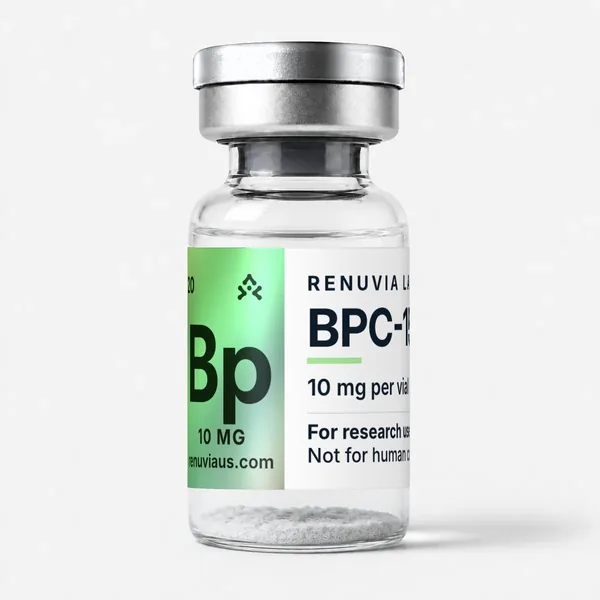
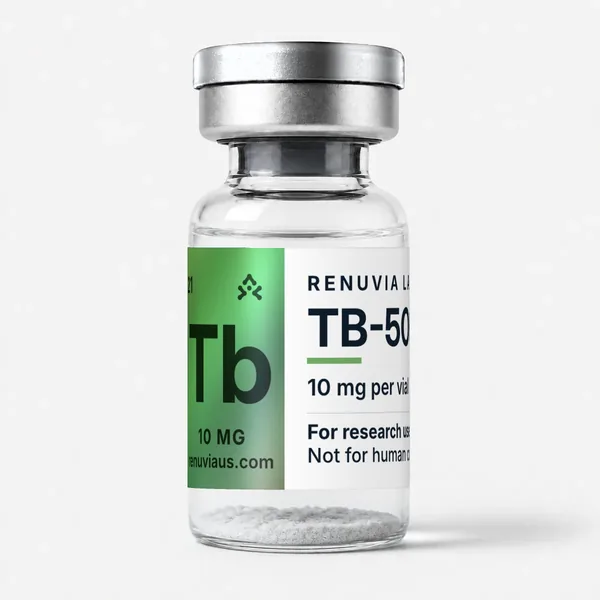
Side by side
| Specification | BPC-157 | TB-500 |
|---|---|---|
| Category | Peptides | Peptides |
| Form | Lyophilized powder | Lyophilized powder |
| Fill amount | 10 mg | 10 mg |
| Sequence | Gly-Glu-Pro-Pro-Pro-Gly-Lys-Pro-Ala-Asp-Asp-Ala-Gly-Leu-Val (GEPPPGKPADDAGLV) | Ac-Leu-Lys-Lys-Thr-Glu-Thr-Gln-OH (Ac-LKKTETQ) |
| Molecular formula | C62H98N16O22 | C38H68N10O14 |
| Molecular weight | 1419.5 g/mol | 889.01 g/mol |
| CAS number | 137525-51-0 | 885340-08-9 |
| Research status | Preclinical — not approved anywhere | Preclinical — no human data |
| Evidence levels | in-vitro, animal, early-clinical | in-vitro, animal |
| Cited sources | 5 | 7 |
Identifiers describe the compound as listed on each product page; see each page for the source of every value. Purity and testing results appear only on a published Certificate of Analysis.
What this comparison covers
BPC-157 and TB-500 are named together so often that they can sound like two versions of one thing. They are not. BPC-157 is a 15-amino-acid peptide named after a protein isolated from human gastric juice [1]; TB-500 is a seven-amino-acid acetylated fragment of thymosin beta-4, an actin-binding protein [2]. This page sets them side by side on structure, origin, the published evidence and regulatory status.
It does not rank them, and it makes no statement about use, administration or outcomes. Every scientific claim below is drawn from the sources listed at the end.
Shared ground
Both are short synthetic peptides made by solid-phase synthesis [1][2], and both are discussed mainly in connection with tissue-repair research, although the animal work behind that reputation is extensive for BPC-157 and very limited for TB-500 itself. FDA found no approved product containing either one [1][2].
Both went through the same FDA process in 2026. FDA's compounding safety-risk page lists both among bulk substances nominated but withdrawn, citing possible immunogenicity and limited or no safety information [3]. FDA's July 2026 briefing documents weighed against adding either to the 503A bulks list [1][2]; the advisory committee then voted 8 to 6, with one abstention, to recommend adding each. Those votes are nonbinding and require rulemaking [4]. Both are prohibited at all times in sport under the WADA 2026 Prohibited List [5].
Both are sold by Renuvia Labs as lyophilized powder for laboratory research use only, with verified identifiers on each product page and a lot Certificate of Analysis in the COA library once testing is complete.
How they differ
Structure and size differ. BPC-157 is Gly-Glu-Pro-Pro-Pro-Gly-Lys-Pro-Ala-Asp-Asp-Ala-Gly-Leu-Val (1419.5 g/mol, free base) [1]. TB-500 is Ac-Leu-Lys-Lys-Thr-Glu-Thr-Gln (889.01 g/mol, free base), matching residues 17 to 23 of the 43-amino-acid thymosin beta-4 with an acetyl group on the first residue [2]. The two sequences share no meaningful overlap.
Origin differs. BPC-157 was first synthesized in Zagreb in the early 1990s from a protein described in gastric juice [1]. TB-500 was identified by an anti-doping laboratory in 2012 as the peptide present in a product sold under that name; the authors described it as the acetyl derivative of the major actin-binding site of thymosin beta-4 [6]. FDA states that thymosin beta-4 and TB-500 are not the same substance [2].
The evidence bases differ in kind. BPC-157 has a long publication list, but most of it comes from one research centre, and independent laboratories have contributed only a handful of studies [7]; a 2025 systematic review of its orthopaedic research found 35 preclinical studies and one human case series [8]. FDA identified five small, short human studies [1]. TB-500 has almost no literature of its own: FDA found no human data of any kind, and in the one cell wound-closure study it cited, TB-500 did not differ significantly from vehicle [2]. The larger literature usually quoted for TB-500, including human eye-drop trials, concerns full-length thymosin beta-4, a different molecule [9].
WADA classifies them differently: BPC-157 under S0, Non-Approved Substances, and thymosin beta-4 and its derivatives including TB-500 under S2.3, Growth Factors and Growth Factor Modulators [5].
Which research questions each is associated with
BPC-157 appears in literature on rodent models of gut, tendon, ligament, muscle, bone and neurological injury, and in small human studies FDA identified in ulcerative colitis, knee pain and interstitial cystitis [1][8].
TB-500 appears mainly in anti-doping chemistry, which characterizes the fragment and develops methods to detect it and its metabolites [2][6]. Questions about cell migration, actin binding and wound or corneal repair belong to the full-length thymosin beta-4 literature [9].
The only study identified that tested the two together, a 2026 rat Achilles-tendon study, found no added effect from combining them over either alone [10].
Questions researchers ask
- What is the difference between BPC-157 and TB-500?
- They are unrelated peptides. BPC-157 has 15 amino acids and is named after a protein isolated from human gastric juice. TB-500 has seven amino acids and is an acetylated fragment (residues 17-23) of thymosin beta-4. Their sequences, origins and research literatures are separate.
- Is TB-500 the same as thymosin beta-4?
- No. FDA states they are not the same substance [2]. Thymosin beta-4 is a 43-amino-acid protein; TB-500 is a seven-amino-acid fragment of it. Human trials of thymosin beta-4 eye drops do not apply to TB-500.
- Which has more human research?
- BPC-157 has five small, short human studies identified by FDA, one available only as a meeting abstract [1]. FDA found no human studies of TB-500 [2]. Neither amounts to an established human evidence base, and neither is approved anywhere.
- Have BPC-157 and TB-500 been studied together?
- One 2026 rat Achilles-tendon study had a combined group and found no additional effect on the measured outcomes compared with either peptide alone [10]. No human study of the combination was identified.
- Are these products for human use?
- No. Both are sold for laboratory research use only by qualified researchers. They are not drugs, dietary supplements, cosmetics or foods.
Sources
- FDA. Briefing document: BPC-157 (free base) and BPC-157 acetate. Pharmacy Compounding Advisory Committee, July 23–24, 2026
- FDA. Briefing document: TB-500 (free base) and TB-500 acetate. Pharmacy Compounding Advisory Committee, July 23–24, 2026
- FDA. Certain bulk drug substances for use in compounding that may present significant safety risks (updated April 2026)
- DLA Piper. FDA advisory committee recommends adding six peptides to bulk list. July 31, 2026
- WADA. The 2026 Prohibited List, sections S0 and S2.3
- Esposito S, et al. Synthesis and characterization of the N-terminal acetylated 17-23 fragment of thymosin beta 4 identified in TB-500. Drug Test Anal 2012
- Józwiak M, et al. Reply to Sikiric et al. BPC 157 Therapy: Targeting Angiogenesis and Nitric Oxide's Cytotoxic and Damaging Actions. Pharmaceuticals 2025
- Vasireddi N, et al. Emerging Use of BPC-157 in Orthopaedic Sports Medicine: A Systematic Review. HSS J 2025
- Sosne G, Ousler GW. Thymosin beta 4 ophthalmic solution for dry eye: a randomized, placebo-controlled, Phase II clinical trial. Clin Ophthalmol 2015
- Biçer O, et al. Effects of BPC-157 and TB-500 on Achilles tendon healing in rats. Jt Dis Relat Surg 2026
For laboratory research use only by qualified researchers. Not for human or veterinary use. Not a drug, dietary supplement, cosmetic or food. Not evaluated by the FDA for any use.