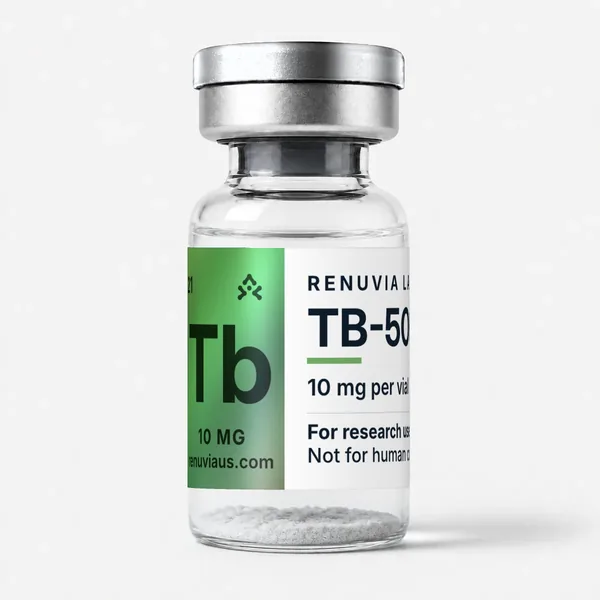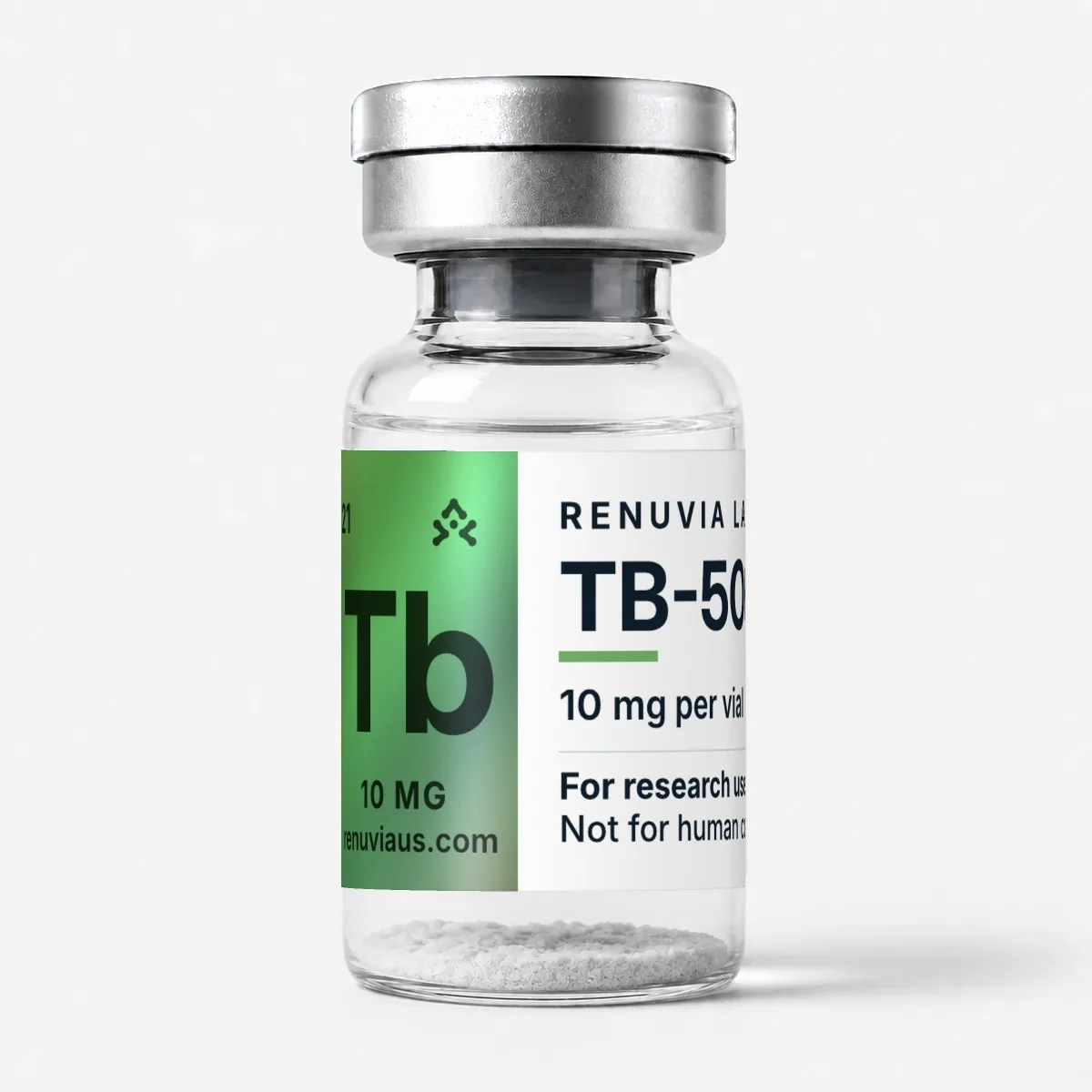
TB-500
10 mg · Lyophilized powder
Sold out
Synthetic peptide related to thymosin beta-4.
Need larger quantities? Wholesale pricing for qualified businesses
For laboratory research use only by qualified researchers. Not for human or veterinary use. Not a drug, dietary supplement, cosmetic or food. Not evaluated by the FDA for any use.
Quick Summary
Preclinical — no human dataTB-500 is a synthetic seven-amino-acid peptide (Ac-LKKTETQ) that matches amino acids 17–23 of thymosin β4, the region of that protein that binds actin. Most tissue-repair research has used full-length thymosin β4, not this fragment. FDA has found no human data for TB-500, and it is not approved anywhere.
Areas of research
- Thymosin β4 biology
- Wound and corneal repair
- Tendon healing
- Anti-doping analysis
- Amount
- 10 mg
- Form
- Lyophilized powder
- References
- 7 cited
- COA
- Batch report pending
- Free U.S. shipping on orders of $150 or more
- Lyophilized powder in a sealed vial
Research Use Notice. This product is intended for laboratory and research purposes. It is not intended for human consumption or personal medical use. Product information is provided for scientific and educational context only. See our Research Use Policy.
Why Researchers Study It
- Whether a short fragment can reproduce activities reported for full-length thymosin β4
- The actin-binding region of thymosin β4 and its role in cell migration
- Rat tendon healing, in one 2026 study that tested TB-500 alone and with BPC-157
- Detection methods for anti-doping laboratories
What It Is
TB-500 is a short synthetic peptide, Ac-Leu-Lys-Lys-Thr-Glu-Thr-Gln, with an acetyl group on its first amino acid.
TB-500 is a short synthetic peptide, Ac-Leu-Lys-Lys-Thr-Glu-Thr-Gln, with an acetyl group on its first amino acid. It corresponds to amino acids 17 to 23 of thymosin β4, a 43-amino-acid protein found naturally in the body.
This stretch overlaps the part of thymosin β4 that binds actin, a structural protein inside cells. FDA states plainly that thymosin β4 and TB-500 are not the same substance.
Its chemical identity was characterized in a 2012 analytical study of material sold as TB-500. Full-length thymosin β4 has a separate research history in cell migration, blood-vessel formation and wound repair, including eye-drop trials.
Direct data on the fragment are thin. In a cell study cited in FDA's 2026 review, TB-500 itself did not significantly speed wound closure in fibroblasts, while a shorter breakdown product had a small effect.
How It Works
3 established · 3 proposed or under investigation
Established
- Chemically characterized as the N-terminally acetylated 17–23 fragment of thymosin β4
- Full-length thymosin β4 binds actin monomers inside cells
- No mechanism has been established for TB-500 itself
Proposed / under investigation
- Full-length thymosin β4: proposed to promote cell migration, new blood vessels and reduced scar-forming cells in wounds
- Whether the 17–23 fragment shares these activities is not established; in the cell study FDA cited, it did not significantly speed wound closure
- A shorter breakdown product (Ac-LKKTE) showed a small effect in that same study
Research Status & Evidence
Preclinical — no human data
FDA's 2026 review identified no human studies of TB-500. Controlled human trials exist only for full-length thymosin β4, a different molecule.
Types of evidence
- Available: Cell & lab studies
- Available: Animal studies
- Not available: Early human studies
- Not available: Clinical trials
- Not available: Approved medical use
Evidence specific to TB-500 is limited to analytical chemistry, a few cell experiments, pharmacokinetic studies in horses and rats, and one rat tendon study. FDA's 2026 review identified no human clinical, pharmacokinetic or safety data. Human trials of full-length thymosin β4 eye drops do not apply directly to this fragment.
Areas of research
- Thymosin β4 biologyactin binding and cell migration
- Wound and corneal repairfull-length thymosin β4 research
- Tendon healingone 2026 rat Achilles study
- Anti-doping analysischaracterization and detection of TB-500
Limitations
- Not approved anywhere; FDA found no approved TB-500 product and no human data
- Findings for full-length thymosin β4 cannot be assumed to apply to the 17–23 fragment
- FDA's 2026 briefing proposed not adding TB-500 to the 503A bulks list, citing poor characterization and no human safety data; its compounding safety-risk page notes possible immunogenicity
- A Phase II dry-eye trial of full-length thymosin β4 eye drops did not meet its primary endpoints
- Thymosin β4 and its derivatives, such as TB-500, are prohibited in sport under the WADA 2026 Prohibited List (S2)
Specifications
10 mg · Lyophilized powder · CAS 885340-08-9
- Product
- TB-500
- Category
- Peptides
- Size
- 10 mg
- Form
- Lyophilized powder
- Synonyms
- Thymosin beta-4 fragment; Thymosin beta-4 fragment (LKKTETQ); Ac-LKKTETQ; Thymosin β4 (17–23)
- CAS number
- 885340-08-9
- Molecular formula
- C38H68N10O14
- Molecular weight
- 889.01 g/mol
- Sequence
- Ac-Leu-Lys-Lys-Thr-Glu-Thr-Gln-OH (Ac-LKKTETQ)
- SKU
- REN-TB500-10
Molecular data: Free base, not the acetate salt, per FDA's TB-500 briefing document for the July 2026 Pharmacy Compounding Advisory Committee (FDA lists no CAS number for the acetate).
Testing & COA Batch report pending
Research References (7)
Linked sources · last reviewed October 2026
- Esposito et al. Synthesis and characterization of the N-terminal acetylated 17-23 fragment of thymosin beta 4 identified in TB-500. Drug Test Anal 2012 · PubMed 22962027
- Goldstein et al. Thymosin β4: a multi-functional regenerative peptide. Basic properties and clinical applications. Expert Opin Biol Ther 2012 · PubMed 22074294
- Sosne & Ousler. Thymosin beta 4 ophthalmic solution for dry eye: a randomized, placebo-controlled, Phase II clinical trial. Clin Ophthalmol 2015 · PubMed 26056426
- Biçer et al. Effects of BPC-157 and TB-500 on Achilles tendon healing in rats. Jt Dis Relat Surg 2026 · PubMed 42542926
- FDA. Briefing document: TB-500 (free base) and TB-500 acetate. Pharmacy Compounding Advisory Committee, July 23–24, 2026 · fda.gov
- FDA. Certain bulk drug substances for use in compounding that may present significant safety risks (updated April 2026) · fda.gov
- WADA. The 2026 Prohibited List (copy published by JADCO) · jadco.gov.jm
Summaries are written by Renuvia Labs from the sources above for educational context only. Last reviewed October 30, 2026.
Frequently Asked Questions
Is TB-500 the same as thymosin beta-4?
No. TB-500 is the short acetylated peptide Ac-Leu-Lys-Lys-Thr-Glu-Thr-Gln (Ac-LKKTETQ), which matches amino acids 17 to 23 of thymosin β4, a 43-amino-acid protein. FDA states plainly that thymosin β4 and TB-500 are not the same substance.
What are the TB-500 molecular weight and CAS number?
As the free base, TB-500 (Ac-LKKTETQ) has the formula C38H68N10O14, a molecular weight of 889.01 g/mol and CAS number 885340-08-9, per FDA's July 2026 briefing document. FDA lists no CAS number for the acetate salt.
When will TB-500 be available?
TB-500 is sold out right now. Use "Email me when it's available" on this page and we send one email when it is back in stock. Every lot is listed in the COA library with its Certificate of Analysis once the lab issues it.
What size is the TB-500 vial?
TB-500 is supplied as a single 10 mg lyophilized vial (10 mg total peptide content stated on the label).
What is TB-500?
TB-500 is a synthetic seven-amino-acid peptide (Ac-LKKTETQ) that matches amino acids 17–23 of thymosin β4, the region of that protein that binds actin. Most tissue-repair research has used full-length thymosin β4, not this fragment. FDA has found no human data for TB-500, and it is not approved anywhere.
Is there a TB-500 coupon or discount code?
There is no public coupon code. New customers get a first-order discount for joining the Renuvia email list, volume pricing starts at 2 vials of TB-500, and U.S. shipping is free over $150. Codes on third-party coupon sites are not valid here.
What are other names for TB-500?
TB-500 is also referred to as Thymosin beta-4 fragment, Thymosin beta-4 fragment (LKKTETQ), Ac-LKKTETQ, Thymosin β4 (17–23).
What are the CAS number and molecular weight of TB-500?
TB-500: CAS number 885340-08-9; molecular formula C38H68N10O14; molecular weight 889.01 g/mol. Sequence: Ac-Leu-Lys-Lys-Thr-Glu-Thr-Gln-OH (Ac-LKKTETQ). (Free base, not the acetate salt, per FDA's TB-500 briefing document for the July 2026 Pharmacy Compounding Advisory Committee (FDA lists no CAS number for the acetate).)
What sizes is Renuvia Labs TB-500 available in?
TB-500 is listed in 10 mg, supplied as lyophilized powder in a sealed glass vial. It is sold for laboratory research use only.
Where is the Certificate of Analysis for TB-500?
Certificates of Analysis are published per lot in the Renuvia Labs COA library, searchable by product, SKU or lot number. TB-500 shows "pending" there until the current lot's report exists; it is then linked on this page too.
Is this in stock?
Yes, unless the page says sold out. You reserve it with no payment today, and we email payment instructions in approximately 1–2 business days. Your order ships once payment arrives.
What form is this product supplied in?
Peptides and research compounds ship as lyophilized (freeze-dried) powder in a sealed glass vial. The fill amount printed on the product page and label is the total content of the vial.
Is this product for human use?
No. All Renuvia Labs products are sold strictly for laboratory research use. They are not for human or animal consumption and are not intended to diagnose, treat, cure or prevent any disease.
Do you offer volume pricing?
Yes. Per-vial pricing drops automatically at 2, 3 and 5 vials of the same product; the current tiers are shown next to the price. For larger quantities, see our wholesale program.
How much is shipping?
Free U.S. shipping on orders of $150 or more; $8.95 flat rate below that.
Do you ship outside the U.S.?
No. Renuvia Labs ships to U.S. addresses only. Research institutions outside the U.S. can enquire through the wholesale program.