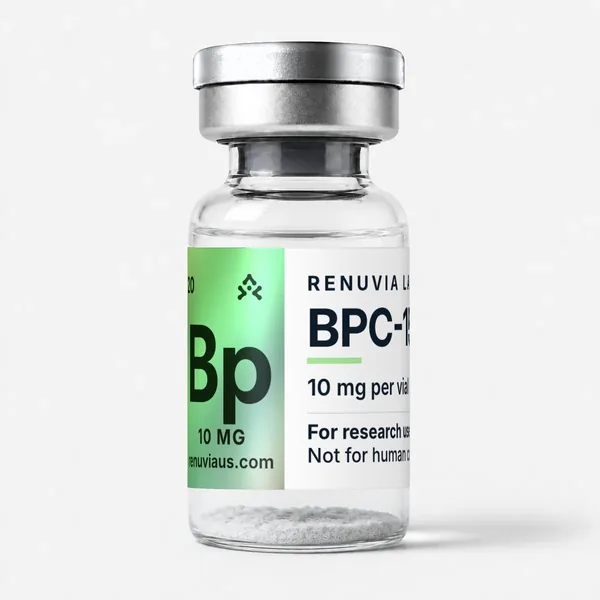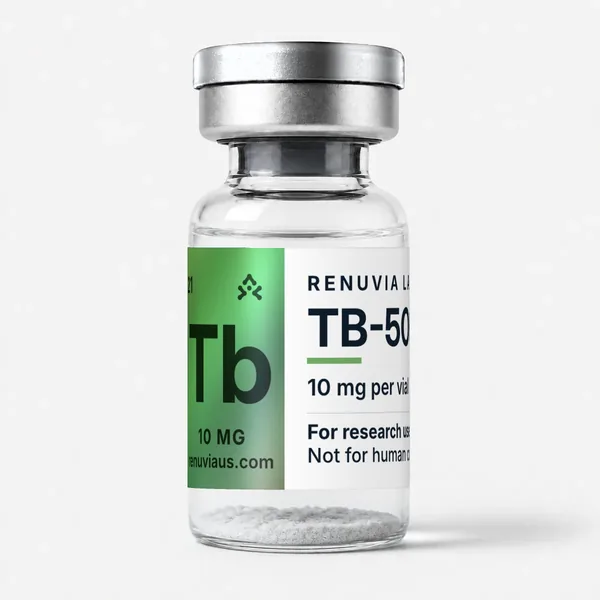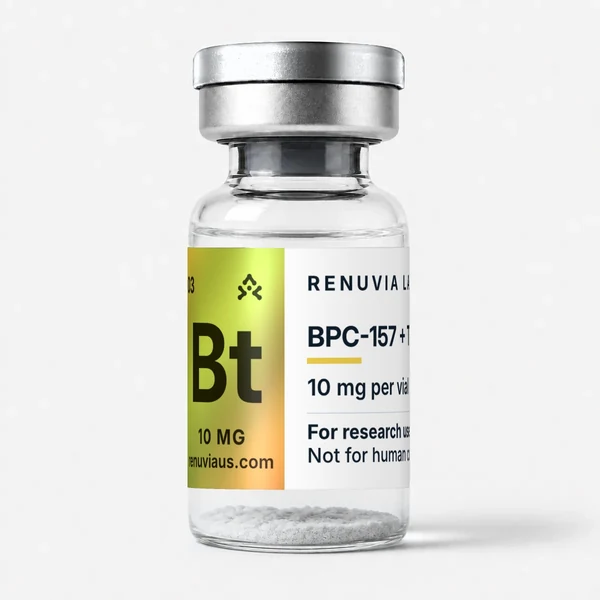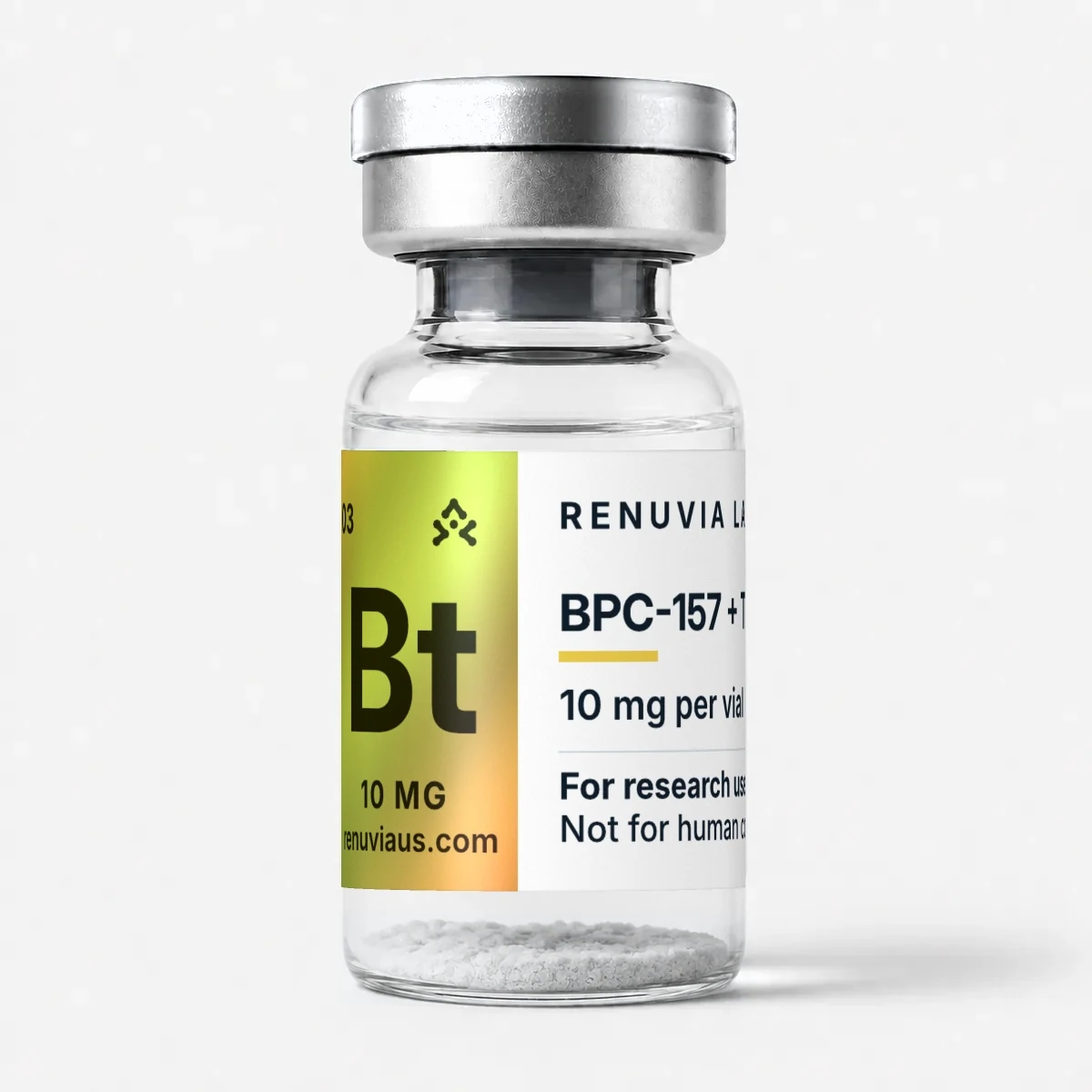
BPC-157 + TB-500 Blend
In stock10 mg · Lyophilized powder
In stock · reserve now
Equal-parts research blend of BPC-157 and TB-500.
Looking for BPC-157 or TB-500 on its own?
Both are now listed on their own as 10 mg vials. They're sold out right now; join the email waitlist on either page. BPC-157 10 mg
Need larger quantities? Wholesale pricing for qualified businesses
or
For laboratory research use only by qualified researchers. Not for human or veterinary use. Not a drug, dietary supplement, cosmetic or food. Not evaluated by the FDA for any use.
How ordering works
This product is in stock. Reserve it now; no payment is collected today. Estimated availability is approximately 1–2 business days. We'll contact you when your reservation is ready for payment.
- 1Reserve todayNo payment now
- 2We confirm itAbout 1–2 business days
- 3Payment requestBy email, with a secure link
- 4ShipsTracking by email
Quick Summary
Preclinical — not approvedAn equal-parts blend of two separately studied synthetic peptides: BPC-157, a 15-amino-acid fragment of a stomach protein, and TB-500, a short fragment of the repair-related protein thymosin β4. Both have been studied mainly in animal models of tendon, muscle and wound repair. Neither is approved, and the blend itself has almost no published research.
Areas of research
- Tendon and ligament repair
- Musculoskeletal injury models
- Wound and corneal repair
- Dry-eye and corneal trials
- Anti-doping analysis
- Amount
- 10 mg
- Form
- Lyophilized powder
- References
- 5 cited
- COA
- Published
- Free U.S. shipping on orders of $150 or more
- Lyophilized powder in a sealed vial
- Batch COA available
Research Use Notice. This product is intended for laboratory and research purposes. It is not intended for human consumption or personal medical use. Product information is provided for scientific and educational context only. See our Research Use Policy.
Why Researchers Study It
- BPC-157 has been studied in rodent models of tendon, ligament, muscle and gut injury
- Thymosin β4, the protein TB-500 is taken from, is involved in cell migration and new blood-vessel formation
- Researchers are interested in whether the two act on overlapping tissue-repair pathways
- A 2026 rat tendon study tested them alone and together and found no added benefit from combining them
What It Is
This vial is an equal-parts mixture of two separate synthetic peptides, BPC-157 and TB-500.
This vial is an equal-parts mixture of two separate synthetic peptides, BPC-157 and TB-500. Each has its own research history, and the two were studied independently long before anyone combined them.
BPC-157 is a 15-amino-acid peptide described as a stable fragment of a protein found in gastric juice. TB-500 is a short acetylated peptide (Ac-LKKTETQ) that matches residues 17–23 of thymosin β4, a naturally occurring protein. TB-500 is not the same thing as full-length thymosin β4.
Both components have been studied in relation to tissue repair. BPC-157 appears mainly in rodent models of tendon, ligament, muscle, bone and gut injury. Full-length thymosin β4 has been investigated for cell migration, new blood-vessel formation and wound repair, including eye-drop trials run by its developers.
Interest in pairing them comes from that overlapping repair theme. Very little published work tests them together: one 2026 rat Achilles-tendon study included a combined group and reported no added benefit over either peptide alone.
How It Works
2 established · 4 proposed or under investigation
Established
- TB-500 is chemically characterized as the N-terminal acetylated 17–23 fragment of thymosin β4
- Neither BPC-157, TB-500 nor this combination has an established mechanism of action in humans
Proposed / under investigation
- BPC-157: rodent studies link it to growth-hormone receptor expression, blood-vessel growth pathways and lower inflammatory cytokines
- Thymosin β4 (full-length): proposed to promote cell migration, new blood vessels and reduced scar-forming cells in wounds
- Whether the short TB-500 fragment shares the activities of full-length thymosin β4 is not well characterized
- In the one rat study testing both together, authors suggested the peptides may act on overlapping downstream pathways
Research Status & Evidence
Preclinical — not approved
Evidence for both components comes mainly from animal studies. Controlled human trials exist only for full-length thymosin β4 eye drops, not for TB-500 or this blend.
Types of evidence
- Not available: Cell & lab studies
- Available: Animal studies
- Available: Early human studies
- Not available: Clinical trials
- Not available: Approved medical use
Almost all BPC-157 data come from animal studies; a 2025 systematic review found 35 preclinical studies and a single human case series, all low-level evidence. Controlled human trials exist for full-length thymosin β4 eye drops, not for the TB-500 fragment. The combination appears in only one rat tendon study.
Areas of research
- Tendon and ligament repairmostly rodent models for BPC-157
- Musculoskeletal injury modelsmuscle and bone healing in animals
- Wound and corneal repairfull-length thymosin β4 research
- Dry-eye and corneal trialsfull-length thymosin β4 eye drops
- Anti-doping analysisdetection methods for TB-500
Limitations
- No published study has examined this product or a fixed 1:1 BPC-157/TB-500 blend
- Neither peptide is FDA-approved; FDA has noted no human exposure data for the TB-500 fragment and only limited safety information for BPC-157
- A Phase II dry-eye trial of full-length thymosin β4 eye drops did not meet its primary endpoints
- Both substances are prohibited in sport under the WADA 2026 Prohibited List
Specifications
10 mg · Lyophilized powder
- Product
- BPC-157 + TB-500 Blend
- Category
- Blends
- Size
- 10 mg
- Form
- Lyophilized powder
- Synonyms
- BPC-157 / TB-500 blend; Wolverine stack (forum nickname for a BPC-157 + TB-500 combination)
- SKU
- REN-BPCTB-10
Testing & COA Batch report available
- Batch RN-2610-BPCTB · HPLC-UV (purity), LC-MS (identity) · Freedom Diagnostics Testing · 2026-10-3199.26% purity · Identity: confirmed · BPC-157 5.60 mg, TB-500 5.01 mg measured (5 mg + 5 mg on label); thymosin beta-4 0.23 mg also reported. The lab report lists the sample as the "Black Cap" vialView COA
Research References (5)
Linked sources · last reviewed September 2026
- Vasireddi et al. Emerging Use of BPC-157 in Orthopaedic Sports Medicine: A Systematic Review. HSS J 2025 · PubMed 40756949
- Esposito et al. Synthesis and characterization of the N-terminal acetylated 17-23 fragment of thymosin beta 4 identified in TB-500. Drug Test Anal 2012 · PubMed 22962027
- Goldstein et al. Thymosin β4: a multi-functional regenerative peptide. Basic properties and clinical applications. Expert Opin Biol Ther 2012 · PubMed 22074294
- Sosne & Ousler. Thymosin beta 4 ophthalmic solution for dry eye: a randomized, placebo-controlled, Phase II clinical trial. Clin Ophthalmol 2015 · PubMed 26056426
- Biçer et al. Effects of BPC-157 and TB-500 on Achilles tendon healing in rats. Jt Dis Relat Surg 2026 · PubMed 42542926
Summaries are written by Renuvia Labs from the sources above for educational context only. Last reviewed September 28, 2026.
Frequently Asked Questions
Do you sell BPC-157 or TB-500 on its own?
Yes. BPC-157 10 mg and TB-500 10 mg are listed on their own (sold out right now; each page has an email waitlist). This blend is the two together, 5 mg + 5 mg in one lyophilized vial.
Why is this blend called the Wolverine stack?
"Wolverine stack" is a forum nickname for a BPC-157 + TB-500 combination. Renuvia Labs lists it under its component names, BPC-157 + TB-500 Blend, 10 mg.
What is BPC-157 + TB-500 Blend?
An equal-parts blend of two separately studied synthetic peptides: BPC-157, a 15-amino-acid fragment of a stomach protein, and TB-500, a short fragment of the repair-related protein thymosin β4. Both have been studied mainly in animal models of tendon, muscle and wound repair. Neither is approved, and the blend itself has almost no published research.
Is there a BPC-157 + TB-500 Blend coupon or discount code?
There is no public coupon code. New customers get a first-order discount for joining the Renuvia email list, volume pricing starts at 2 vials of BPC-157 + TB-500 Blend, and U.S. shipping is free over $150. Codes on third-party coupon sites are not valid here.
What are other names for BPC-157 + TB-500 Blend?
BPC-157 + TB-500 Blend is also referred to as BPC-157 / TB-500 blend, Wolverine stack (forum nickname for a BPC-157 + TB-500 combination).
What sizes is Renuvia Labs BPC-157 + TB-500 Blend available in?
BPC-157 + TB-500 Blend is listed in 10 mg, supplied as lyophilized powder in a sealed glass vial. It is sold for laboratory research use only.
Where is the Certificate of Analysis for BPC-157 + TB-500 Blend?
Certificates of Analysis are published per lot in the Renuvia Labs COA library, searchable by product, SKU or lot number. BPC-157 + TB-500 Blend shows "pending" there until the current lot's report exists; it is then linked on this page too.
Is this in stock?
Yes, unless the page says sold out. You reserve it with no payment today, and we email payment instructions in approximately 1–2 business days. Your order ships once payment arrives.
What form is this product supplied in?
Peptides and research compounds ship as lyophilized (freeze-dried) powder in a sealed glass vial. The fill amount printed on the product page and label is the total content of the vial.
Is this product for human use?
No. All Renuvia Labs products are sold strictly for laboratory research use. They are not for human or animal consumption and are not intended to diagnose, treat, cure or prevent any disease.
Do you offer volume pricing?
Yes. Per-vial pricing drops automatically at 2, 3 and 5 vials of the same product; the current tiers are shown next to the price. For larger quantities, see our wholesale program.
How much is shipping?
Free U.S. shipping on orders of $150 or more; $8.95 flat rate below that.
Do you ship outside the U.S.?
No. Renuvia Labs ships to U.S. addresses only. Research institutions outside the U.S. can enquire through the wholesale program.