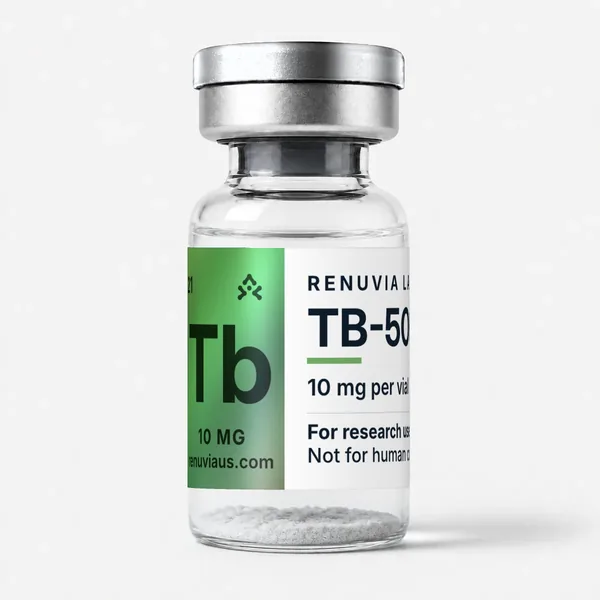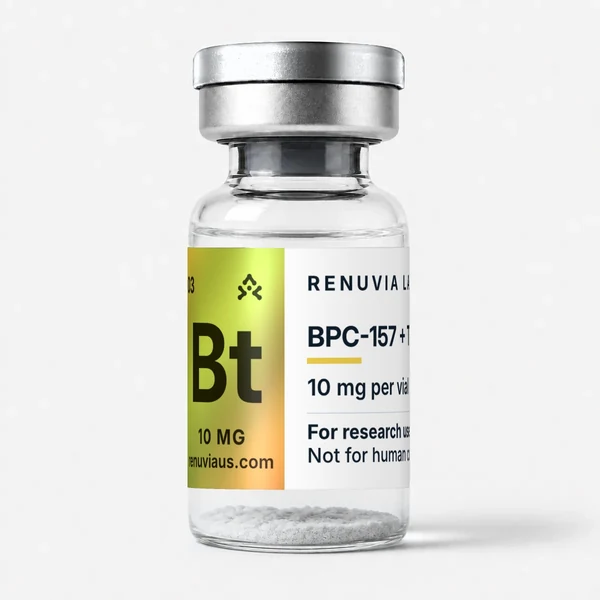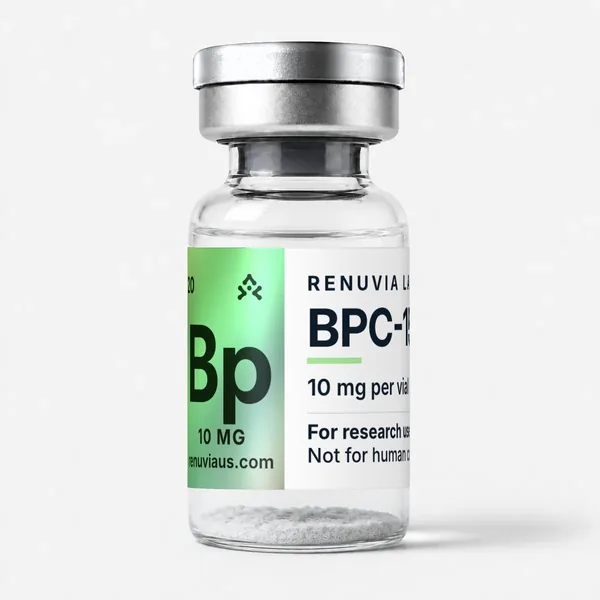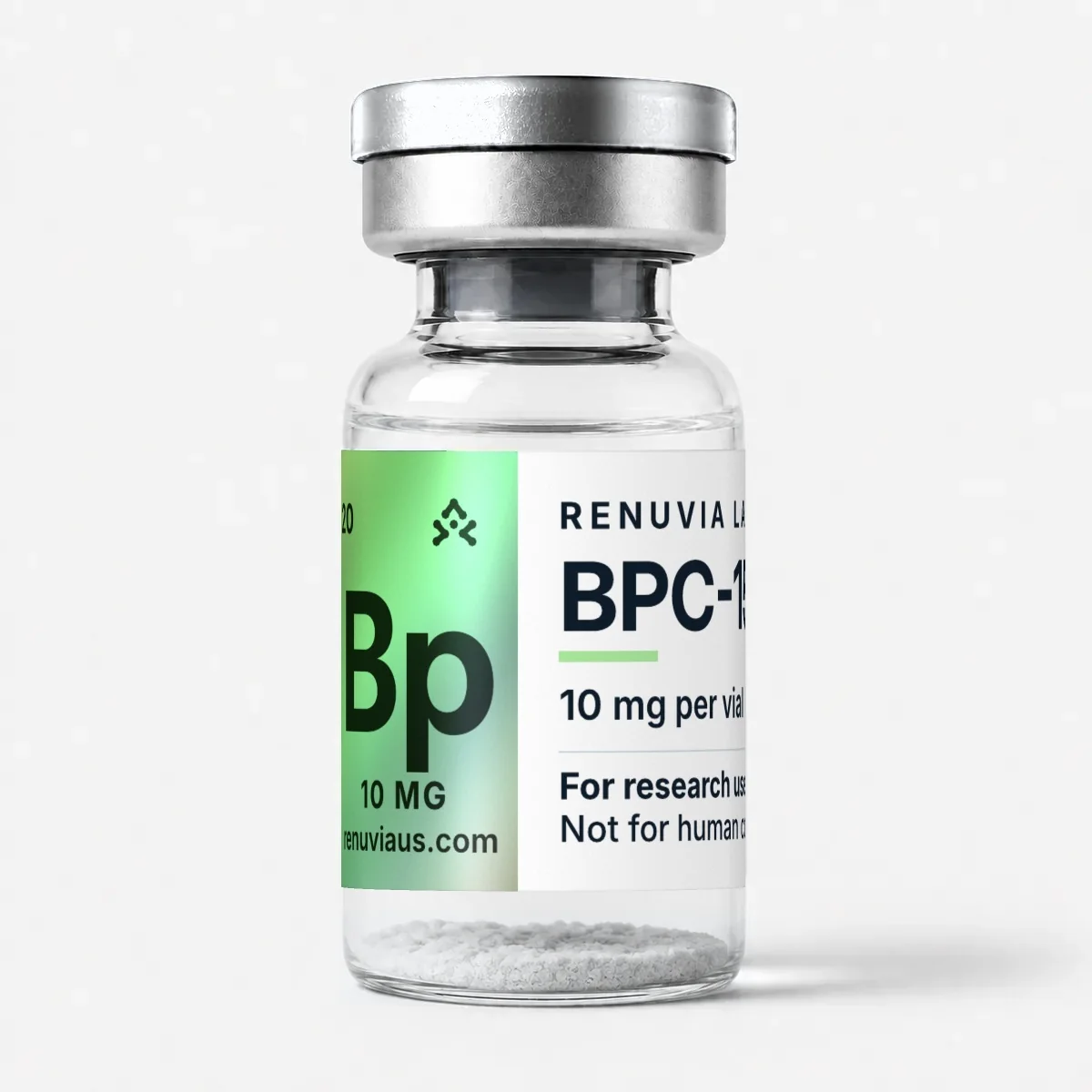
BPC-157
10 mg · Lyophilized powder
Sold out
Synthetic 15-amino-acid peptide (Body Protection Compound 157).
Need larger quantities? Wholesale pricing for qualified businesses
For laboratory research use only by qualified researchers. Not for human or veterinary use. Not a drug, dietary supplement, cosmetic or food. Not evaluated by the FDA for any use.
Quick Summary
Preclinical — not approved anywhereBPC-157 is a synthetic 15-amino-acid peptide whose sequence comes from a larger protein first isolated from human gastric juice. Most research has been done in rats and mice, in models of tendon, muscle, bone and gut injury. A few small human studies exist, and no BPC-157 product is approved in any country.
Areas of research
- Tendon and ligament repair
- Muscle and bone injury
- Gastrointestinal injury
- Anti-doping science
- Amount
- 10 mg
- Form
- Lyophilized powder
- References
- 5 cited
- COA
- Batch report pending
- Free U.S. shipping on orders of $150 or more
- Lyophilized powder in a sealed vial
Research Use Notice. This product is intended for laboratory and research purposes. It is not intended for human consumption or personal medical use. Product information is provided for scientific and educational context only. See our Research Use Policy.
Why Researchers Study It
- Tendon and ligament repair in rodent injury models
- Outgrowth, survival and migration of tendon fibroblasts in cell culture
- Gastrointestinal research, reflecting the peptide's gastric origin, including small human studies in ulcerative colitis
- Whether findings in rats and mice carry over to people, which remains largely untested
What It Is
BPC-157 is a pentadecapeptide, a chain of 15 amino acids (Gly-Glu-Pro-Pro-Pro-Gly-Lys-Pro-Ala-Asp-Asp-Ala-Gly-Leu-Val).
BPC-157 is a pentadecapeptide, a chain of 15 amino acids (Gly-Glu-Pro-Pro-Pro-Gly-Lys-Pro-Ala-Asp-Asp-Ala-Gly-Leu-Val). The name stands for Body Protection Compound 157. FDA describes it as a fragment of a protein originally isolated from human gastric juice.
It was first made synthetically by researchers in Croatia in the early 1990s. It has no approved medical use in any country.
Most published work uses rodent injury models: tendon, ligament, muscle, bone and gut. A 2025 systematic review of its orthopaedic research found 35 preclinical studies and a single human case series, and rated the evidence as low-level.
In 2026 FDA reviewed BPC-157 for its compounding bulks list. It found five small, short human studies with limited safety reporting and toxicology data drawn mainly from one paper, raised concerns about immunogenicity and poorly characterized impurities, and concluded that its evaluation weighed against listing it.
How It Works
2 established · 3 proposed or under investigation
Established
- Its amino acid sequence and chemical identity are characterized (FDA 2026 briefing)
- No mechanism of action has been established in humans
Proposed / under investigation
- In rat tendon fibroblasts, faster cell migration and spreading linked to activation of the FAK–paxillin signaling pathway (cell study)
- Rodent studies link it to growth-hormone receptor expression, blood-vessel growth pathways and lower inflammatory cytokines
- Whether any of these effects occur in humans has not been tested in controlled trials
Research Status & Evidence
Preclinical — not approved anywhere
Evidence is mostly from rodent studies. FDA's 2026 review found only five small, short human studies and no approved BPC-157 product in any country.
Types of evidence
- Available: Cell & lab studies
- Available: Animal studies
- Available: Early human studies
- Not available: Clinical trials
- Not available: Approved medical use
Most evidence comes from rat and mouse studies; a 2025 systematic review rated the orthopaedic literature as low-level evidence. FDA's 2026 review found five small, short human studies with limited safety reporting, and toxicology data drawn mainly from one published paper.
Areas of research
- Tendon and ligament repairrodent models and cell studies
- Muscle and bone injuryanimal models
- Gastrointestinal injuryrodent work and small human studies
- Anti-doping sciencenamed by WADA as a non-approved substance (S0)
Limitations
- Not approved in any country; FDA found no approved product containing BPC-157
- Human data are limited to a few small, short studies with limited safety reporting
- FDA's 2026 briefing concluded its evaluation weighed against adding BPC-157 to the 503A bulks list; FDA's compounding safety-risk page notes possible immunogenicity and limited safety information
- Named as a non-approved substance (S0) on the WADA 2026 Prohibited List
Specifications
10 mg · Lyophilized powder · CAS 137525-51-0
- Product
- BPC-157
- Category
- Peptides
- Size
- 10 mg
- Form
- Lyophilized powder
- Synonyms
- Body Protection Compound 157; PL 14736; BPC 157; Pentadecapeptide BPC 157
- CAS number
- 137525-51-0
- Molecular formula
- C62H98N16O22
- Molecular weight
- 1419.5 g/mol
- Sequence
- Gly-Glu-Pro-Pro-Pro-Gly-Lys-Pro-Ala-Asp-Asp-Ala-Gly-Leu-Val (GEPPPGKPADDAGLV)
- SKU
- REN-BPC-10
Molecular data: Free base, not the acetate salt (acetate CAS 216441-37-1), per FDA's BPC-157 briefing document for the July 2026 Pharmacy Compounding Advisory Committee.
Testing & COA Batch report pending
Research References (5)
Linked sources · last reviewed October 2026
- Vasireddi et al. Emerging Use of BPC-157 in Orthopaedic Sports Medicine: A Systematic Review. HSS J 2025 · PubMed 40756949
- Chang CH et al. The promoting effect of pentadecapeptide BPC 157 on tendon healing involves tendon outgrowth, cell survival, and cell migration. J Appl Physiol 2011 · PubMed 21030672
- FDA. Briefing document: BPC-157 (free base) and BPC-157 acetate. Pharmacy Compounding Advisory Committee, July 23–24, 2026 · fda.gov
- FDA. Certain bulk drug substances for use in compounding that may present significant safety risks (updated April 2026) · fda.gov
- WADA. The 2026 Prohibited List (copy published by JADCO) · jadco.gov.jm
Summaries are written by Renuvia Labs from the sources above for educational context only. Last reviewed October 30, 2026.
Frequently Asked Questions
What is the BPC-157 sequence, molecular weight and CAS number?
BPC-157 is the 15-amino-acid peptide Gly-Glu-Pro-Pro-Pro-Gly-Lys-Pro-Ala-Asp-Asp-Ala-Gly-Leu-Val (GEPPPGKPADDAGLV). As the free base its formula is C62H98N16O22, its molecular weight 1419.5 g/mol and its CAS number 137525-51-0; the acetate salt has CAS 216441-37-1. These values follow FDA's July 2026 briefing document.
Is this the same as the BPC-157 + TB-500 blend?
No. This listing is BPC-157 on its own in a 10 mg vial. The BPC-157 + TB-500 Blend is a separate product that combines the two peptides in one vial.
When will BPC-157 be available?
BPC-157 is sold out right now. Use "Email me when it's available" on this page and we send one email when it is back in stock. Every lot is listed in the COA library with its Certificate of Analysis once the lab issues it.
What size is the BPC-157 vial?
BPC-157 is supplied as a single 10 mg lyophilized vial (10 mg total peptide content stated on the label).
What is BPC-157?
BPC-157 is a synthetic 15-amino-acid peptide whose sequence comes from a larger protein first isolated from human gastric juice. Most research has been done in rats and mice, in models of tendon, muscle, bone and gut injury. A few small human studies exist, and no BPC-157 product is approved in any country.
Is there a BPC-157 coupon or discount code?
There is no public coupon code. New customers get a first-order discount for joining the Renuvia email list, volume pricing starts at 2 vials of BPC-157, and U.S. shipping is free over $150. Codes on third-party coupon sites are not valid here.
What are other names for BPC-157?
BPC-157 is also referred to as Body Protection Compound 157, PL 14736, BPC 157, Pentadecapeptide BPC 157.
What are the CAS number and molecular weight of BPC-157?
BPC-157: CAS number 137525-51-0; molecular formula C62H98N16O22; molecular weight 1419.5 g/mol. Sequence: Gly-Glu-Pro-Pro-Pro-Gly-Lys-Pro-Ala-Asp-Asp-Ala-Gly-Leu-Val (GEPPPGKPADDAGLV). (Free base, not the acetate salt (acetate CAS 216441-37-1), per FDA's BPC-157 briefing document for the July 2026 Pharmacy Compounding Advisory Committee.)
What sizes is Renuvia Labs BPC-157 available in?
BPC-157 is listed in 10 mg, supplied as lyophilized powder in a sealed glass vial. It is sold for laboratory research use only.
Where is the Certificate of Analysis for BPC-157?
Certificates of Analysis are published per lot in the Renuvia Labs COA library, searchable by product, SKU or lot number. BPC-157 shows "pending" there until the current lot's report exists; it is then linked on this page too.
Is this in stock?
Yes, unless the page says sold out. You reserve it with no payment today, and we email payment instructions in approximately 1–2 business days. Your order ships once payment arrives.
What form is this product supplied in?
Peptides and research compounds ship as lyophilized (freeze-dried) powder in a sealed glass vial. The fill amount printed on the product page and label is the total content of the vial.
Is this product for human use?
No. All Renuvia Labs products are sold strictly for laboratory research use. They are not for human or animal consumption and are not intended to diagnose, treat, cure or prevent any disease.
Do you offer volume pricing?
Yes. Per-vial pricing drops automatically at 2, 3 and 5 vials of the same product; the current tiers are shown next to the price. For larger quantities, see our wholesale program.
How much is shipping?
Free U.S. shipping on orders of $150 or more; $8.95 flat rate below that.
Do you ship outside the U.S.?
No. Renuvia Labs ships to U.S. addresses only. Research institutions outside the U.S. can enquire through the wholesale program.