

Comparison
Ipamorelin vs Sermorelin Acetate
Ipamorelin vs sermorelin: a ghrelin-receptor pentapeptide and a 29-amino-acid GHRH fragment. Receptor, structure, history and regulatory status. Research use only.
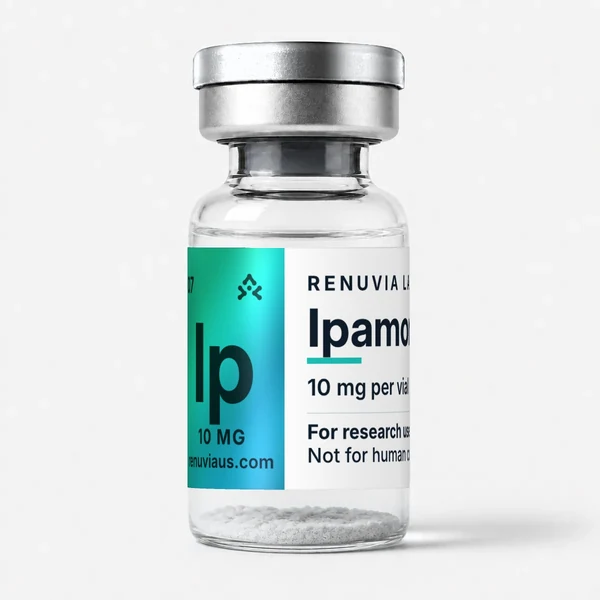
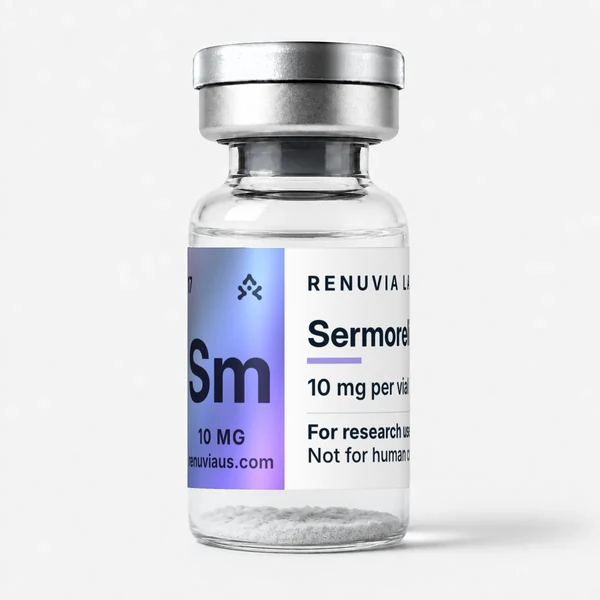
Side by side
| Specification | Ipamorelin | Sermorelin Acetate |
|---|---|---|
| Category | Peptides | Peptides |
| Form | Lyophilized powder | Lyophilized powder |
| Fill amount | 10 mg | 10 mg |
| Sequence | Aib-His-D-2-Nal-D-Phe-Lys-NH2 | YADAIFTNSYRKVLGQLSARKLLQDIMSR-NH2 |
| Molecular formula | C38H49N9O5 | C149H246N44O42S |
| Molecular weight | 711.9 g/mol | 3357.9 g/mol |
| CAS number | 170851-70-4 | 86168-78-7 |
| Research status | Investigational — never approved | Formerly FDA-approved (Geref) — discontinued |
| Evidence levels | in-vitro, animal, clinical-trials | animal, clinical-trials, approved-use |
| Cited sources | 4 | 5 |
Identifiers describe the compound as listed on each product page; see each page for the source of every value. Purity and testing results appear only on a published Certificate of Analysis.
What this comparison covers
Ipamorelin and sermorelin are both studied for one effect, the release of growth hormone from the pituitary gland, but they reach it through two different receptors. That difference, more than anything else, is what separates them. This page sets them side by side on receptor, structure, regulatory history and the published evidence.
It does not rank them, and it makes no statement about use, administration or outcomes. Every scientific claim below is drawn from the sources cited on the two product pages and listed at the end.
Shared ground
Both peptides act on the pituitary gland to stimulate the body's own growth hormone release, rather than supplying growth hormone itself [1][4]. Both appear in anti-doping science, and both are prohibited at all times in sport under the WADA Prohibited List [6].
Both are sold by Renuvia Labs as lyophilized powder for laboratory research use only, with verified identifiers on each product page and a lot Certificate of Analysis in the COA library once testing is complete.
How they differ
They use different receptors. Ipamorelin activates the growth hormone secretagogue receptor (GHS-R1a), the receptor for the stomach hormone ghrelin [1]. Sermorelin acts like growth hormone-releasing hormone (GHRH), the brain signal that tells the pituitary to release growth hormone, through the GHRH receptor [4].
They differ in size and structure. Ipamorelin is a five-amino-acid peptide that includes several unnatural building blocks (Aib-His-D-2-Nal-D-Phe-Lys-NH2; 711.9 g/mol). Sermorelin is a copy of the first 29 amino acids of human GHRH (3357.9 g/mol), the smallest section known to keep the natural hormone's full activity.
Their regulatory histories differ. Ipamorelin, developed at Novo Nordisk as NNC 26-0161, reached a phase 2 trial in bowel-surgery patients that found no significant difference from placebo, and it was never approved [2]. Sermorelin acetate was FDA-approved as Geref, for pituitary testing in 1990 and for idiopathic growth hormone deficiency in children in 1997; the maker stopped selling it in 2008, and FDA later determined the products were not withdrawn for reasons of safety or effectiveness [3][4]. No sermorelin product is currently approved.
Which research questions each is associated with
Ipamorelin appears in literature on selective growth hormone release: in rat and pig studies it released growth hormone without significantly raising the stress hormones ACTH and cortisol, unlike older peptides of its class such as GHRP-6 and GHRP-2 [1]. It also appears in research on ghrelin-like effects on gut movement [2]. FDA lists ipamorelin acetate among bulk substances that may present significant safety risks in compounding [5].
Sermorelin appears in literature on the GHRH side of the growth hormone axis: its former approved pediatric and diagnostic uses, and small, short studies in older adults with mixed results [4].
Questions researchers ask
- What is the difference between ipamorelin and sermorelin?
- They act on different receptors. Ipamorelin is a five-amino-acid agonist of the ghrelin receptor (GHS-R1a); sermorelin is a 29-amino-acid fragment of growth hormone-releasing hormone that acts on the GHRH receptor. Both are studied for stimulating the pituitary's own growth hormone release.
- Which one was FDA-approved?
- Sermorelin acetate was approved as Geref in 1990 and 1997 and discontinued by its maker in 2008; no sermorelin product is approved today [3]. Ipamorelin was never approved; its phase 2 trial in bowel surgery found no significant difference from placebo [2].
- Is sermorelin the same as GHRH?
- It is the first 29 of the natural hormone's 44 amino acids, with an amide at the end: GHRH(1–29)NH2. The full-length, chemically stabilized version of GHRH is tesamorelin.
- What form are they supplied in?
- Both are lyophilized powder in a sealed, lot-numbered vial. The molecular data on each product page describe the free peptide, not the acetate salt.
- Are these products for human use?
- No. Both are sold for laboratory research use only by qualified researchers. They are not drugs, dietary supplements, cosmetics or foods.
Sources
- Raun K, et al. Ipamorelin, the first selective growth hormone secretagogue. Eur J Endocrinol 1998
- Beck DE, et al. Proof-of-concept study of the ghrelin mimetic ipamorelin for postoperative ileus in bowel resection patients. Int J Colorectal Dis 2014
- FDA. Determination that GEREF (sermorelin acetate) was not withdrawn from sale for reasons of safety or effectiveness. Federal Register 2013
- Prakash A, Goa KL. Sermorelin: a review of its use in the diagnosis and treatment of children with idiopathic GH deficiency. BioDrugs 1999
- FDA. Certain bulk drug substances for use in compounding that may present significant safety risks (updated April 2026)
- WADA. The 2026 Prohibited List, section S2.2.4 (copy published by JADCO)
For laboratory research use only by qualified researchers. Not for human or veterinary use. Not a drug, dietary supplement, cosmetic or food. Not evaluated by the FDA for any use.