

Comparison
Selank vs Semax
Selank vs Semax: two Russian-developed seven-amino-acid peptides with the same Pro-Gly-Pro tail but different parents. Structure, research and status. Research use only.
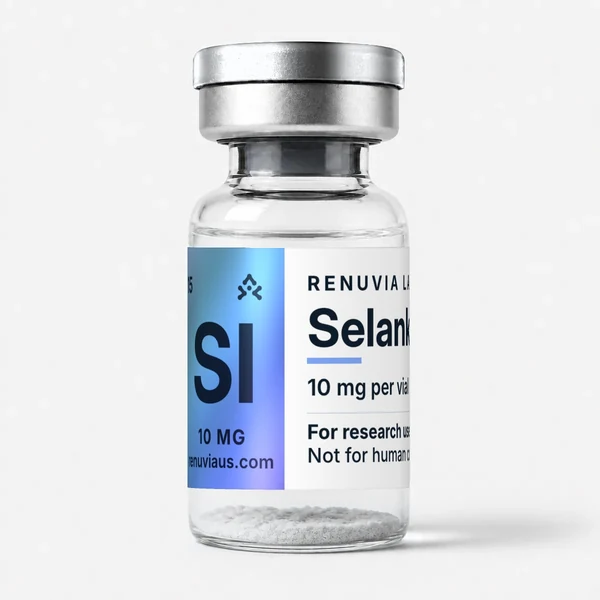
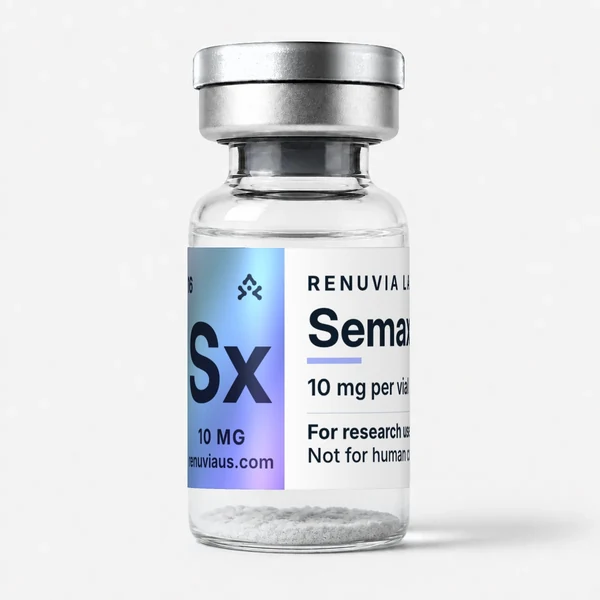
Side by side
| Specification | Selank | Semax |
|---|---|---|
| Category | Peptides | Peptides |
| Form | Lyophilized powder | Lyophilized powder |
| Fill amount | 10 mg | 10 mg |
| Sequence | Thr-Lys-Pro-Arg-Pro-Gly-Pro (TKPRPGP) | Met-Glu-His-Phe-Pro-Gly-Pro (MEHFPGP) |
| Research status | Early clinical research (Russia) — not FDA-approved | Early clinical research (Russia) — not FDA-approved |
| Evidence levels | animal, early-clinical | animal, early-clinical |
| Cited sources | 3 | 3 |
Identifiers describe the compound as listed on each product page; see each page for the source of every value. Purity and testing results appear only on a published Certificate of Analysis.
What this comparison covers
Selank and Semax are often mentioned together because they look alike on paper. Both are synthetic peptides of seven amino acids, both end in the same Pro-Gly-Pro tail added for stability, and both were developed and studied mainly at Russian research institutes. This page sets them side by side on structure, origin and the state of the published evidence.
It does not rank them, and it makes no statement about use, administration or outcomes. Every scientific claim below is drawn from the sources cited on the two product pages and listed at the end.
Shared ground
Both peptides share a design idea: take a short, naturally occurring active fragment and add a Pro-Gly-Pro tail so it breaks down more slowly. Selank is Thr-Lys-Pro-Arg-Pro-Gly-Pro; Semax is Met-Glu-His-Phe-Pro-Gly-Pro. The last three amino acids are identical.
Both also share the same evidence profile. Most published work is in rodents and comes from a small number of Russian groups, human reports are small and appear mainly in Russian-language journals, and there is little independent replication [1][3]. On FDA's compounding safety-risk page, both appear in the table of substances previously in category 2 whose nominations were withdrawn. For each, FDA notes a possible immunogenicity risk from aggregation and peptide-related impurities; for Selank it says it lacks important information on safety in humans, and for Semax that it lacks sufficient information to know whether the substance would cause harm in humans [5]. Neither is approved by the FDA or the European Medicines Agency.
Both are sold by Renuvia Labs as lyophilized powder for laboratory research use only, with verified identifiers on each product page and a lot Certificate of Analysis in the COA library once testing is complete.
How they differ
The parent molecule is the main difference. Selank is built from tuftsin (Thr-Lys-Pro-Arg), a small peptide associated with immune signaling. Semax is built from ACTH(4–7) (Met-Glu-His-Phe), a fragment of adrenocorticotropic hormone that was found to affect the nervous system without the hormone's effects on the adrenal glands.
The research questions follow from those parents. Selank has been studied in rodent models of anxiety-related behavior and for changes in the expression of genes linked to GABA signaling in rat frontal cortex [1], with one 62-patient Russian comparison against the drug medazepam [2]. Semax has been studied in rats for brain-derived neurotrophic factor (BDNF) and its receptor TrkB in the hippocampus [3], and for gene-expression changes after experimental cerebral ischemia [4].
The verified identifiers differ in completeness. Semax has a published molecular formula (C37H51N9O10S), molecular weight (813.9 g/mol) and CAS number (80714-61-0); for Selank the product page currently lists its verified sequence only. The table above shows exactly what has been verified for each.
Which research questions each is associated with
Selank appears in literature on anxiety-related behavior in rodents, GABAergic gene expression and neuroimmune signaling inherited from tuftsin [1][2].
Semax appears in literature on neurotrophin signaling (BDNF and TrkB) and on rat models of stroke [3][4].
In both cases the proposed mechanisms are just that: neither has an established mechanism of action in the sources cited, and the work is concentrated in a few laboratories.
Questions researchers ask
- What is the difference between Selank and Semax?
- Both are seven-amino-acid peptides ending in the same Pro-Gly-Pro tail. Selank is built from tuftsin, an immune-related tetrapeptide; Semax is built from the ACTH(4–7) fragment of adrenocorticotropic hormone. Their research literatures differ accordingly: GABA-related gene expression and anxiety-related behavior in rodents for Selank, BDNF signaling and experimental stroke in rats for Semax.
- Why do Selank and Semax have similar names and structures?
- Both came out of Russian peptide research programs that used the same stabilizing strategy: adding a Pro-Gly-Pro tail to a short active fragment. The tail is shared; the first four amino acids, and so the parent molecule, are different.
- Are Selank and Semax FDA-approved?
- No. Neither is approved by the FDA or the European Medicines Agency, and both appear on FDA's compounding safety-risk page among substances previously in category 2 whose nominations were withdrawn [5].
- What form does Renuvia supply them in?
- Both are supplied as lyophilized powder in a sealed, lot-numbered vial. Renuvia does not sell nasal sprays. Each lot's Certificate of Analysis is published in the COA library.
- Are these products for human use?
- No. Both are sold for laboratory research use only by qualified researchers. They are not drugs, dietary supplements, cosmetics or foods.
Sources
- Volkova A, et al. Selank administration affects the expression of some genes involved in GABAergic neurotransmission. Front Pharmacol 2016
- Zozulia AA, et al. Efficacy and possible mechanisms of action of a new peptide anxiolytic Selank in the therapy of generalized anxiety disorders and neurasthenia. Zh Nevrol Psikhiatr 2008
- Dolotov OV, et al. Semax, an analog of ACTH(4–10) with cognitive effects, regulates BDNF and trkB expression in the rat hippocampus. Brain Res 2006
- Filippenkov IB, et al. Novel insights into the protective properties of ACTH(4-7)PGP (Semax) at the transcriptome level following cerebral ischaemia–reperfusion in rats. Genes 2020
- FDA. Certain bulk drug substances for use in compounding that may present significant safety risks (updated April 2026)
For laboratory research use only by qualified researchers. Not for human or veterinary use. Not a drug, dietary supplement, cosmetic or food. Not evaluated by the FDA for any use.