

Comparison
Sermorelin Acetate vs Tesamorelin
Sermorelin vs tesamorelin: a 29-amino-acid GHRH fragment and a full-length stabilized GHRH analog. Structure, approvals and evidence compared. Research use only.
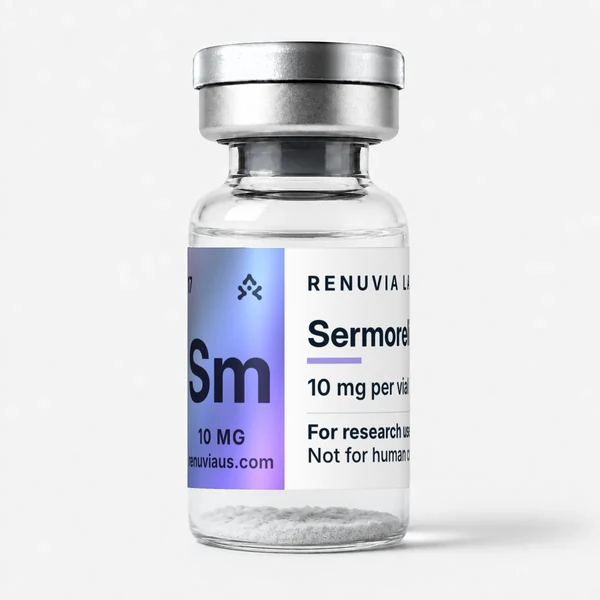
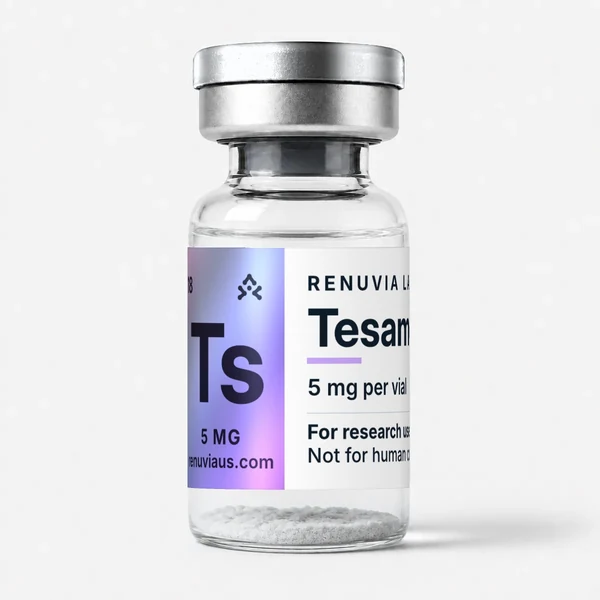
Side by side
| Specification | Sermorelin Acetate | Tesamorelin |
|---|---|---|
| Category | Peptides | Peptides |
| Form | Lyophilized powder | Lyophilized powder |
| Fill amount | 10 mg | 5 mg |
| Molecular formula | C149H246N44O42S | C221H366N72O67S |
| Molecular weight | 3357.9 g/mol | 5135.9 g/mol |
| CAS number | 86168-78-7 | 218949-48-5 |
| Research status | Formerly FDA-approved (Geref) — discontinued | FDA-approved ingredient (Egrifta, 2010) — one indication |
| Evidence levels | animal, clinical-trials, approved-use | clinical-trials, approved-use |
| Cited sources | 5 | 6 |
Identifiers describe the compound as listed on each product page; see each page for the source of every value. Purity and testing results appear only on a published Certificate of Analysis.
What this comparison covers
Sermorelin and tesamorelin are both synthetic versions of growth hormone-releasing hormone (GHRH), the brain signal that tells the pituitary gland to release growth hormone. They differ in how much of the natural hormone they keep and in how each was modified, and those differences led to two very different regulatory stories. This page sets them side by side.
It does not rank them, and it makes no statement about use, administration or outcomes. Every scientific claim below is drawn from the sources cited on the two product pages and listed at the end.
Shared ground
Both act on GHRH receptors in the pituitary gland and stimulate the body's own growth hormone release [2][3]. Both are prohibited at all times in sport under the WADA Prohibited List as GHRH analogues [5].
Both are sold by Renuvia Labs as lyophilized powder for laboratory research use only, with verified identifiers on each product page and a lot Certificate of Analysis in the COA library once testing is complete. This research-grade material is not any approved drug product.
How they differ
Length and modification are the structural difference. Sermorelin keeps the first 29 of GHRH's 44 amino acids, the smallest section known to keep full activity (3357.9 g/mol). Tesamorelin keeps all 44 and adds a trans-3-hexenoyl group to the first amino acid, tyrosine, which makes it more resistant to breakdown (5135.9 g/mol) [3].
Their approvals differ. Sermorelin acetate was approved as Geref for pituitary testing and for idiopathic growth hormone deficiency in children; the maker stopped selling it in 2008, and FDA later determined this was not for reasons of safety or effectiveness [1][2]. Tesamorelin is the active ingredient of Egrifta, approved in 2010 for one narrow indication: reducing excess abdominal fat in adults with HIV who have lipodystrophy. Its label states it is not indicated for weight loss and that its long-term cardiovascular safety has not been established [3].
The evidence behind each differs in kind. Sermorelin's approval rested on pediatric trials in which height velocity improved over 12 months but was lower than with somatropin [2]. Tesamorelin's rests on phase 3 randomized, placebo-controlled trials in adults with HIV [4], followed by randomized trials of liver fat in the same population.
Which research questions each is associated with
Sermorelin appears in literature on pediatric growth hormone deficiency, pituitary function testing and small studies of age-related growth hormone decline [2].
Tesamorelin appears in literature on HIV-associated lipodystrophy, liver fat in people with HIV, and comparisons between full-length stabilized GHRH analogues and shorter fragments such as sermorelin [3][4].
Questions researchers ask
- What is the difference between sermorelin and tesamorelin?
- Both are synthetic GHRH analogs. Sermorelin is the first 29 amino acids of the natural hormone; tesamorelin is all 44, with a trans-3-hexenoyl group added for stability. Sermorelin was approved as Geref and discontinued in 2008; tesamorelin is the active ingredient of Egrifta, approved for one HIV-related indication.
- Is tesamorelin approved?
- Tesamorelin is the active ingredient of Egrifta, FDA-approved in 2010 to reduce excess abdominal fat in adults with HIV and lipodystrophy [3]. Research-grade tesamorelin is not that approved drug product.
- Why is tesamorelin heavier than sermorelin?
- It is longer: 44 amino acids against 29, plus the hexenoyl group. The product pages give 5135.9 g/mol for tesamorelin and 3357.9 g/mol for sermorelin, both for the free peptide rather than the acetate salt.
- What form are they supplied in?
- Both are lyophilized powder in a sealed, lot-numbered vial, with each lot's Certificate of Analysis published in the COA library.
- Are these products for human use?
- No. Both are sold for laboratory research use only by qualified researchers. They are not drugs, dietary supplements, cosmetics or foods.
Sources
- FDA. Determination that GEREF (sermorelin acetate) was not withdrawn from sale for reasons of safety or effectiveness. Federal Register 2013
- Prakash A, Goa KL. Sermorelin: a review of its use in the diagnosis and treatment of children with idiopathic GH deficiency. BioDrugs 1999
- FDA / DailyMed. EGRIFTA SV (tesamorelin) prescribing information, Theratechnologies, revised December 2025
- Falutz J, et al. Metabolic effects of a growth hormone-releasing factor in patients with HIV. N Engl J Med 2007
- WADA. The 2026 Prohibited List, section S2.2.4 (copy published by JADCO)
For laboratory research use only by qualified researchers. Not for human or veterinary use. Not a drug, dietary supplement, cosmetic or food. Not evaluated by the FDA for any use.